The Hare Moon

HARE02

Whether you celebrate Beltane or May Day or nothing at all, it’s good to take note of the first day of May, as it brings us ever closer to summer. It’s no wonder the day was traditionally noted by our agricultural antecedents in Europe as a time for the celebration of warmth and fruitfulness, fire and fertility!

I find this particular May Day exhilarating, as it marks the beginning of the month I’ve selected for release of my next novel, Shadow of the Hare. This particular celebration is set for May 21, the day of the full moon that is known is some quarters as “The Hare Moon”.

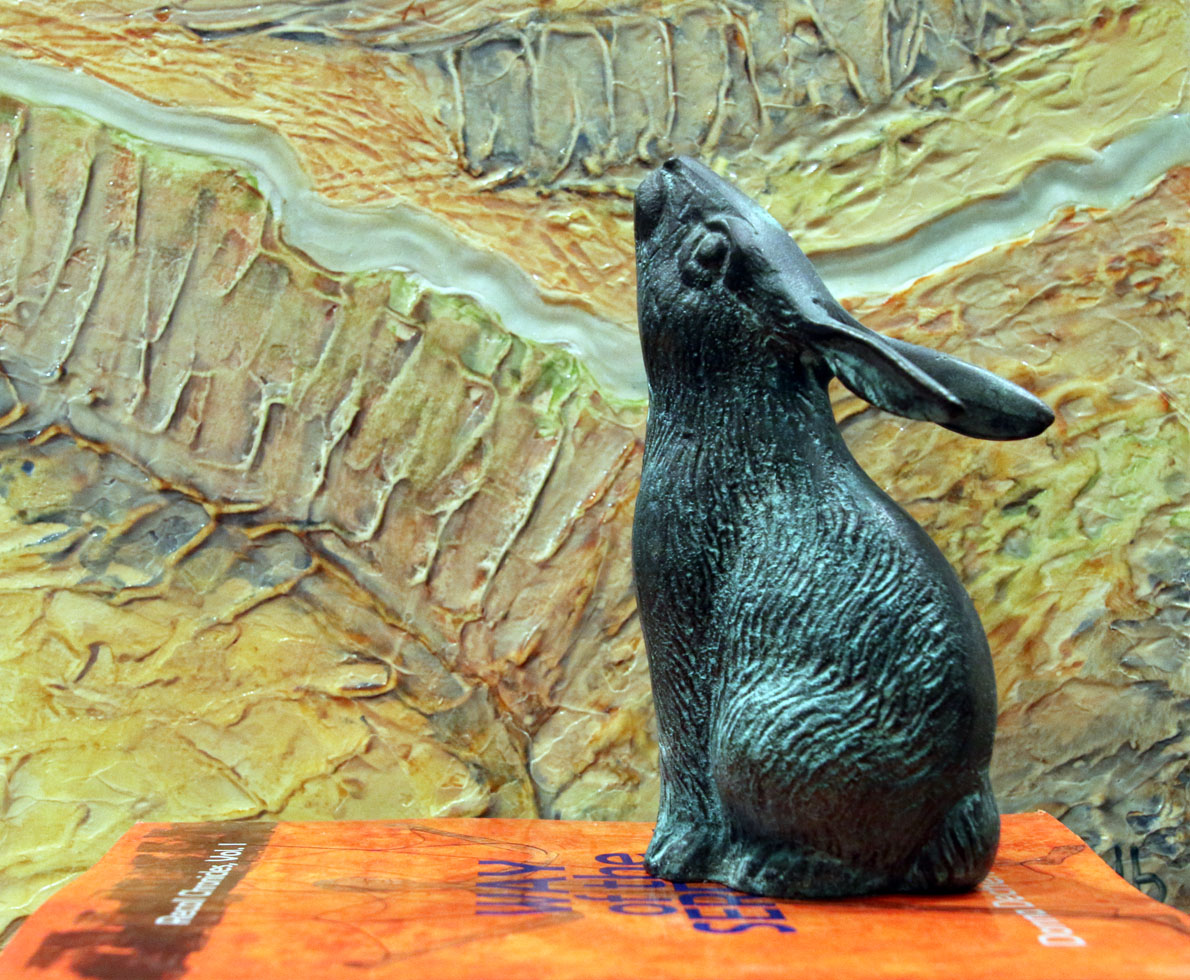
Associations of hares (sometimes rabbits) with the moon abound in folklore and I’ve always felt a personal resonance with the creatures. The symbolism has worked its way into my novel. Here’s a small taste–it was hard to find one without spoilers!

I remember the year 2053, the year of the Global Peace Accord that officially put an end to war. Lio and I had gone to watch the celebratory fireworks displays on the D. C. mall, sitting in the shadow of one of the big war memorials next to a shallow pool. We lingered, watching the full moon rise, long after the crowd dispersed.
“How do you think they finally got the big weapons manufacturers and military corporations to sign on to the accord?” I asked.
“I’ve wondered about that. I wish I knew. They’ll never make much profit just making explosives for fireworks.” Lio grinned at me. “Although tonight’s show was pretty spectacular. And by that I mean over-the-top excessive.”
I snuggled up closer to Lio as a breeze rose up, rippling the water on the pond where the full moon was reflected. “Of course, weapons aren’t just guns and bombs these days,” I mused.
“Did you ever see a man in the moon when you were a kid?” Lio asked.
“Yeah. At least I think I did.”
“Did you know that in some other parts of the world peo­ple see a hare on the face of the moon?”
“I read about that once. I could never see it though. I guess we see what we’re conditioned to see, right? Whatever our cul­ture tells us is there?”
“Probably. And maybe we want it to be a living thing,” he suggested, “something with a face and eyes. Something we can relate to.”
“Can you still see a face on the moon?” I asked.
“Not really.”
“Me either. Though sometimes I wish I could.” 

PRE-ORDER Shadow of the Hare on Kindle and receive it May 21st! 

Celebrate release of Shadow of the Hare May 21st, 1 pm to 4 pm, at Half Price Books on North Lamar in Austin. Get your signed paperback copy and register for free gifts!
One Is the Agent

Donna-LOres2016-0318

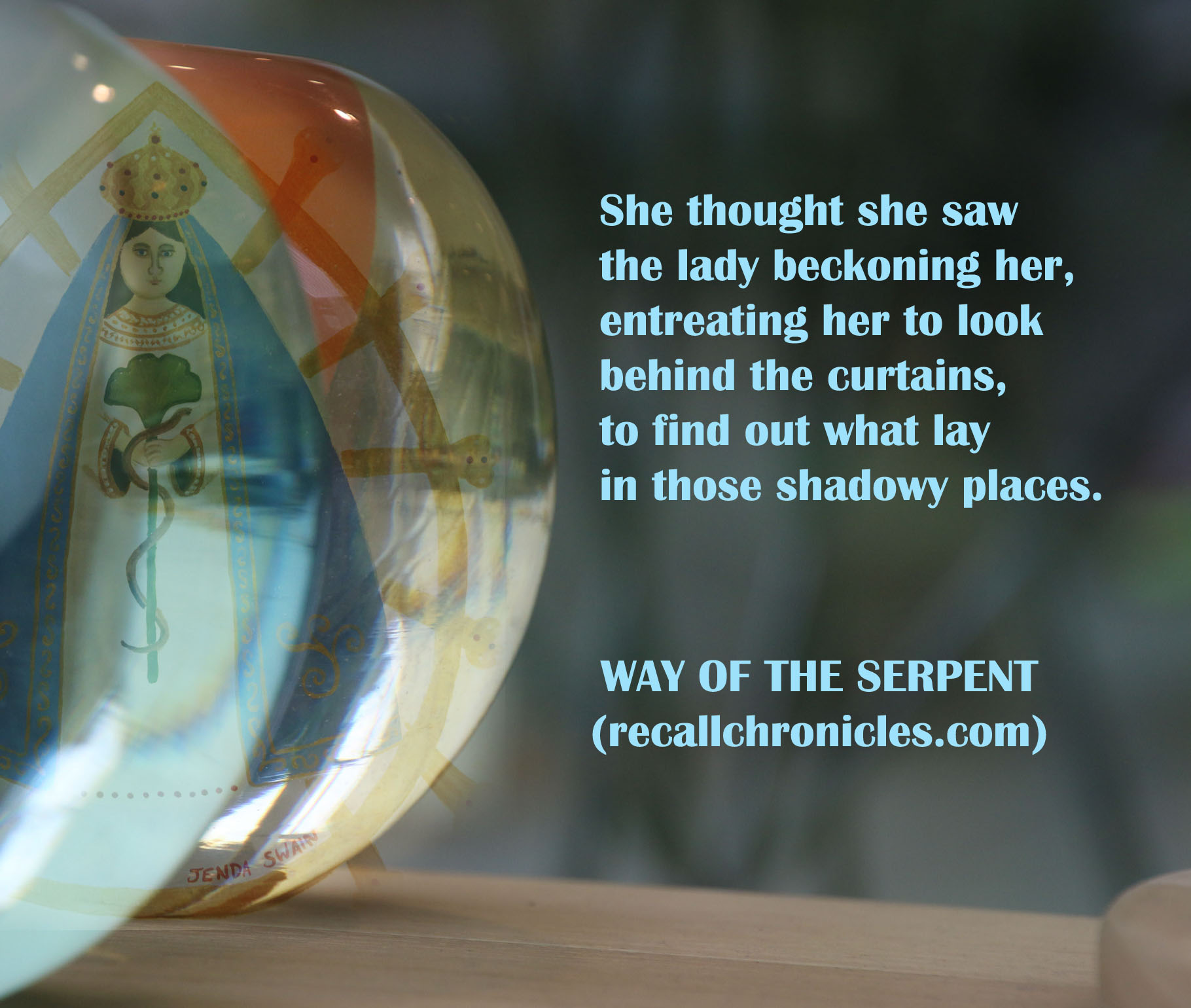
I needed a new cover for the re-issue of Way of the Serpent, something that could provide the basis of covers for sequels in what has now become the Recall Chronicles. I analyzed the covers of dozens of other dystopian science fiction novels. I perused photographs available online. I searched through my own considerable inventory of photographs.

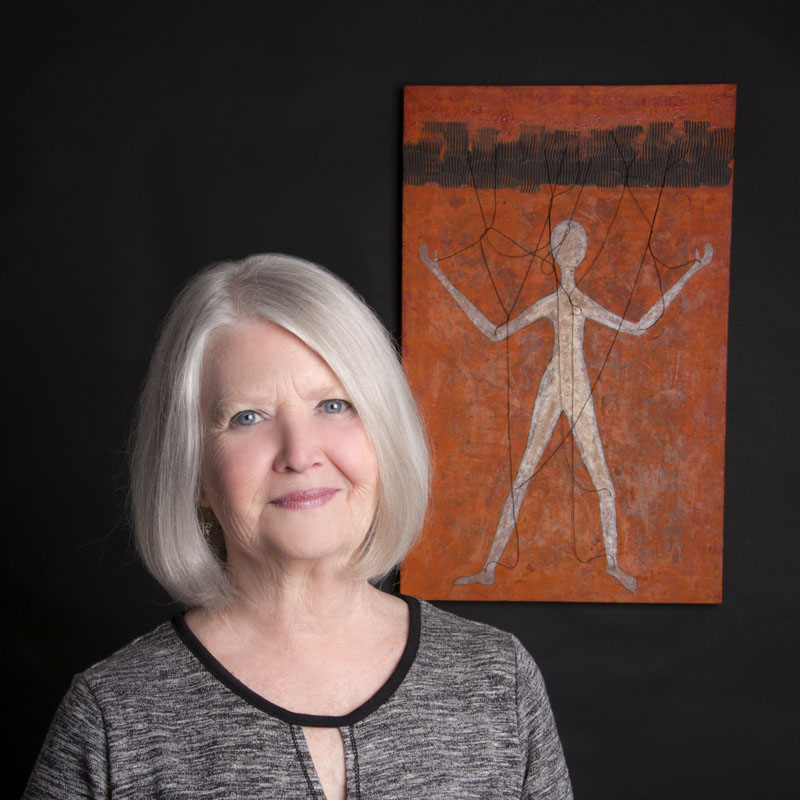
I kept going back to this one painting (see above), to which I’d attached a rather complicated title, a title that was in fact a line from a Buddhist practice I did sometimes: “One is the agent, caught in the reaction of cause and effect.”

The more I thought about it, the more I came to the conclusion that this painting and my novels were coming from the same space, a space in which agency constantly grapples with conditions that are, after all, oftentimes a result of one’s own actions. We’re not puppets, but we’re never free of entanglements, never entirely free agents.

The characters in my novels are like this, valiantly battling the circumstances of their lives, circumstances that are, to a varying extent, their own fault.

If these sound like the kind of characters you’d like to read about, you’ll like Way of the Serpent and (coming soon!) Shadow of the Hare.

Where No One Has Gone

IMG_8781

When I was a child, I used to imagine going to a place no one had ever been to before. There would be no trails, no trash, no trace of human presence. Over the years, as I studied the history of human migrations and tracked our exploding population and greedy exploitation of the remotest corners of our planet, I came to the realization that such places probably no longer exist. As I recently journeyed through West Texas, New Mexico, and Arizona, I decided I should simply revise my dream: not to go where no one has gone before, but simply to go where I have never been and to bring myself fully to the encounter.

In a recent Huffington Post article, Daniel Crockett writes about the trend in our culture toward seeking “wildness”, including purchasing the trips and costumes and paraphernalia that tell us we are explorers of the wilds. But we delude ourselves. “The wild you seek is not on some frozen summit, empty ocean or silent plain,” he writes. “The wild is within you.”

I find myself in agreement with Crockett’s proposal, and yet I would caution against naïve mythologizing of this encounter with our own wildness and with the natural world. It is something that my protagonist in Vol. II of the Recall Chronicles (Shadow of the Hare) deals with after she flees her urban world and lands in West Texas. “My excursion into nature quickly became a retreat into my own fanciful world,” she observes.

If we truly wish to meet the natural world, we must meet it as it is and not as we desire it to be or imagine it to be. It may not be as “wild” as we would like, but if we meet it with the wildness of our own hearts, our own nature, I believe we will find the encounter more than satisfying.

Coming in May 2016 – Shadow of the Hare (Recall Chronicles, Vol. II) – Malia Poole is a stubbornly dissident author and bibliophile in a world where books have ceased to matter and barely exist. Emerging from fifty years of self-imposed exile, she discovers a world far more terrifying that the one she fled.

Vol I – Way of the Serpent – available now. 

The Journey Continues

FullSizeRender 8

I’m back at my home base in Austin, Texas, after a week on the road and a journey of a couple thousand miles. I traveled on, undaunted by small inconveniences like having some dude in Lebanon (yes, the country of Lebanon) try to use my credit card on the third day of my travels, resulting in the card being cancelled and me being left with only my bank card and cash on hand. Undaunted, as well, by another dude, the one driving the white Lexus, who failed to stop soon enough and plowed into the back of my car exiting off I-30 in Fort Worth.

Never mind those things. It was an amazing trip. There were vast expanses of geologic time strewn out before me, forcing me to imagine ancient seas, volcanic eruptions, eons of uplift and erosion. There were people whose experience and narrative of American history is vastly different from my own, people with gentle manners and firm rules: no photography, no recording. They told me what I needed to know. They expected me to remember it, and I’m sure I will.

My bedtime reading last night delved back into Marilynne Robinson’s Gilead, the passage where the preacher protagonist reflects on a wartime sermon he never preached. “The parents of these young soldiers would come to me and ask me how the Lord could allow such a thing. I felt like asking them what the Lord would have to do to tell us He didn’t allow something. But instead I would comfort them by saying we would never know what their young men had been spared.”

My own journey through life continues and I remain undaunted by small miseries. Who knows what suffering could have been my lot if I weren’t so fortunate? Happy travels!

Exploring Hopi Country

IMG_2538

I came to Arizona in search of deeper insight into one of the characters you will meet in Vol. III of the Recall Chronicles. Her name is Dextra and she is a Hopi woman. Since my arrival here on Second Mesa yesterday afternoon, I have held wide-ranging conversations with a half dozen real Hopi women, asking them questions and listening to them muse about what life might be like for a woman in the Hopi world in the 22nd Century. Through them, I’ve come to know Dextra much more fully. I’ll have to rewrite several scenes and conversations, but that’s okay; that was what I hoped would come from this journey.

I don’t want to tell you too much about Dextra. Just know that she’s waiting to meet you in a book called Flight of the Owl. I will, however, share with you a few tidbits of information that came my way today.

  • Some Hopi believe that owls are protectors, while others see them as messengers, possibly of bad news.
  • There is a wild plant on the mesas that bears tiny, tiny green leaves that taste like mint. Only stronger.
  • Dogs are protected beings among the Hopi (which explains why this is the only area on my journey where I’ve seen dogs!). I was told that sometimes Navaho people will drop off litters of puppies at Hopi shops, knowing the dogs will be well cared for.

Have you read Vol. I – Way of the Serpent?

Respect

OWLfeather4blog

As I prepare to set off on a journey to Arizona to contextualize the Hopi character of Dextra Honanie (Recall Chronicles, Vol. III – Flight of the Owl), I must take heed of J.K. Rowling’s current tribulations in Pottermore.

Rowling is in process of attempting to construct a bridge between the world of Harry Potter and “magic in North America”.  Adrienne Keene, in her blog “Native Appropriations”, takes Rowling to task for several transgressions, beginning with the reification of something called “Native Americans”. Keene rightfully points out that this is a broad and diverse cultural category, encompassing as it does Inuit, Apache, Hopi, Iroquois, Navaho, Cherokee, and many other equally distinctive societies.

Rowling also gets into some awkward attempts to intertwine the fictional world of wizardry with some real events in American history. I fully understand the temptation of providing a Potteresque slant on the Salem witch trials, but I’m mystified by Rowling’s statement that the Magical Congress of the United States of America (MACUSA) was founded in 1693, a full 83 years before the founding of the United States of America itself. Magic, I guess.

One of the most charming features of Rowling’s marvelous world of wizardry has always been its existence as a world apart from specific time and place, a world exemplified – to my mind at least – by Platform Nine and Three-Quarters. Trying to link up with history and a named continent full of real people with complex, still vibrant cultures kind of messes with the magic.

My own fictional world in The Recall Chronicles is clearly linked to real places and potentially real times. And that is why I want very much to get my Hopi character right, or at least plausible enough to be acceptable to Hopi readers. I’m looking forward to my adventures in Arizona!

(More musings on fiction, fantasy, and the real world are in the works.)

Way of the Serpent is speculative fiction.

Truth and Fiction

ARTisLIES

Although I continue to hold a position as Professor Emerita of Anthropology at my former institution, I stopped being actively engaged in anthropology almost a decade ago. Or did I? The further I get beyond that watershed date called “retirement”, the more easily I see the profound influences of social science on my life as it continues to unfold.

Today I decided I needed to look back on a textbook I used for a class I taught on Neanderthals, in which we studied novels about Neanderthals alongside the scientific treatises. The book I pulled off the shelf is called Fiction & Social Research: By Ice or Fire, edited by Anna Banks and Stephen P. Banks.

The introduction the Bankses wrote for that book struck a deep chord with me and may account at least in part for my eventual turn toward fiction writing. They credit Eudora Welty, Nadine Gordimer and Milan Kundera for inspiring them “to think about the nature of truth and the place of fact in storytelling, and the relation of truth and facticity to the imagination.”

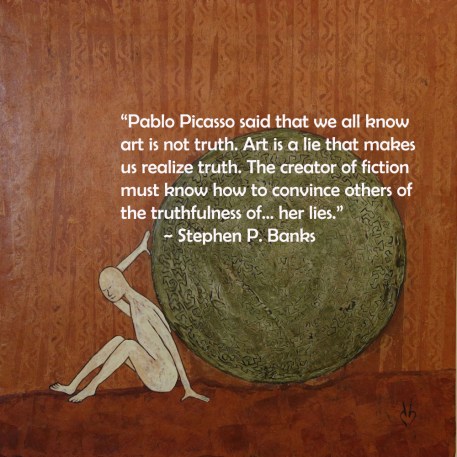
Perhaps the most important thing I learned from Anna and Stephen is that “facts don’t always tell the truth, or a truth worth worrying about, and the truth in a good story – its resonance with our felt experience… – sometimes must use imaginary facts.” From them I learned the concept of “verisimilitude”, the notion that a story can have an unmistakable ring of truth even when the “facts” are entirely made up.

So here’s a big “Thank you!” to a couple of social scientists of great imagination and courage who planted in this social scientist the seeds of a late-blooming desire to write stories – completely made-up stories – that have the ring of truth.

Where Are You From?

"Trying To Blend In" 8 x 10 framed, $300

“Trying To Blend In” 8 x 10 framed, $300

My collegiate study abroad was the summer of 1969 at the University of Graz, Austria. There I met two women – mother and daughter – and when I asked them that time-worn, tedious question “Where are you from?” they looked confused. I believe they were originally from Bulgaria, but due to politics and undisclosed personal matters, they were officially stateless, traveling around Europe on United Nations passports.

“How marvelous!” I thought at the time. “How liberating to not be tethered to one country and one identity, to be free to move about the world unburdened by someone else’s prejudices about your origins!” I didn’t discuss this with the mother and daughter, though now I fervently wish I had.

I’ve developed some new perspective on this question of stateless persons over the years and especially during the past year as I’ve watched political turmoil and violence turning people loose in the world with nowhere to go, nowhere to belong, nowhere to call home. We call them refugees or, more politely, migrants.

The world appears to be increasingly full of such people, the effluent of conflict and economic catastrophe. Just yesterday I read an article about Nepal, where children born of a Nepali mother and a foreign father cannot claim Nepali citizenship except through a difficult and highly uncertain political process. Without their official citizenship certificates these people “cannot vote, open a bank account, sit for many official examinations, register the birth of a child, buy or sell property, get a passport, or even obtain a mobile SIM card.” They are effectively stateless persons.

Instead of loosening the restrictions of social and political participation, we appear to be getting more and more chary about according citizenship and belonging to our fellow human beings. My youthful infatuation with the notion of global citizenship, one planetary society, was naïve. Although we may be annoyed when people ask the question, we all want to be from somewhere that loves us.

Read more from Donna Dechen Birdwell.

Happy Lunar New Year!

MONKEYfire

Although I am neither an astrologer nor a prognosticator of any proven reliability, I would like to offer a few observations regarding this Lunar New Year.

The year we are leaving behind is the Year of the Wood Sheep. Sheep, as we know, are gentle animals who move about in herds, becoming easily distressed when left on their own, lost with no sense of direction, crying plaintively. In some eastern cultures, the sheep year is instead a goat year. We also know a thing or two about goats, especially scapegoats. “Wood” or “wooden” are terms often used to convey a sense of thickness, unresponsiveness, lack of intelligence.

The year we are moving into is the Year of the Fire Monkey. Unlike sheep, monkeys are lively, jovial, emotional, unpredictable. In stories, they are often tricksters. As for the fire, well, fire burns wood. Fire is one of the most useful tools ever domesticated by humankind, but also one of the most dangerous.

Based on these thoroughly idiosyncratic observations here is my prediction for the year ahead: things are about to get interesting!