Ask Questions!

recall10

“You need to ask more questions!”

This line is in the opening scene that launches the action of both Way of the Serpent and Shadow of the Hare. It’s advice that I hope readers of my books take to heart and, to that end, I’ve included lists of questions at the conclusion of both books.

One of the things I’ve been hoping for is that one of my books might become a “book group” selection—and that has now happened! A group of professors at Lamar University read my book and then Skyped me in for a discussion last week.

It was a thoroughly delightful interchange. I learned that Way of the Serpent caused them to think more deeply about the whole question of memories, their imperfection, the importance of how we share them with others, how we invest them in the objects with which we surround ourselves. I learned that they found it reassuring to see quality human relationships surviving all the gadgets and conveniences of my hypothesized future. I learned that they found the story’s ending (over which I agonized so much in the writing) to be poignant and appropriate. They liked the excitement of the story itself as it unfolded. They also liked the artificial trees with miniaturized 3D printers producing leaves in appropriate seasonal colors!

In my new book, Shadow of the Hare, the protagonist is a novelist who muses about her own writing:

“Were my stories the kind that lured people into unrealistic delusions? I hoped not. I hoped they were, instead, the kind of stories that opened windows onto the true nature of things, shedding light, inviting fresh thinking, dispelling confusion.”

If you like asking questions, contemplating answers, I hope you’ll come to my next public reading – June 9 at Malvern Books – where we’ll have the opportunity for a Q&A session!

Here are the questions I came up with for my books. I’m sure you’ll have more!

Looking at the Moon

shadow

I don’t choose the titles of my books lightly. Way of the Serpent dealt with an old New Guinea folk tale about a contest at the beginning of time for human destiny, a contest between a bird and a snake to see whether human beings would be like snakes, shedding their skins and living forever, or like birds that have to die.

Shadow of the Hare takes on the question of our human tendency to project our own wishes and desires onto the objects and experiences of our world. What do we see on the face of the moon—a human face? A hare? It depends.

My highest aspiration is to write books that readers will want to go back to—to think about, to read again. I want to raise questions in the reader’s mind that will lead somewhere, not offering easy answers to life’s tough questions, but offering, perhaps, a sip of wine to aid digestion.

Here’s to your enjoyment of my next book—cheers!

Available on Amazon.

Book launch event Saturday, May 21, 1 to 4 pm at Half Price Books on North Lamar, Austin, TX. 

Read the first chapters of Way of the Serpent HERE

Whatever Became of Books

books

Malia Poole, the protagonist in Shadow of the Hare (Vol. II of the Recall Chronicles), worked at a secondhand bookstore called Codex2 for nearly thirty years, during which “the story industry” was transformed by the rise of the plutocracy. It was a difficult time for a dissident author like Malia, but not an altogether unhappy time.

We worked together, conspiring with friends who shared our distaste for the society as it was, as it was becoming. There were periods of anger and frustration, but there was camaraderie in the midst of it. The further they drove us underground, the stronger our bonds became. We trusted no one but one another. We found ways of avoiding the corporate police, moving in the shadows, the interstices, doing what we needed to do without attracting too much attention. It wasn’t the most effective form of activism, but we became expert at being invisible. 

Shadow of the Hare is available for preorder.

Free download of Way of the Serpent expires at midnight, April 9.

The Journey Continues

FullSizeRender 8

I’m back at my home base in Austin, Texas, after a week on the road and a journey of a couple thousand miles. I traveled on, undaunted by small inconveniences like having some dude in Lebanon (yes, the country of Lebanon) try to use my credit card on the third day of my travels, resulting in the card being cancelled and me being left with only my bank card and cash on hand. Undaunted, as well, by another dude, the one driving the white Lexus, who failed to stop soon enough and plowed into the back of my car exiting off I-30 in Fort Worth.

Never mind those things. It was an amazing trip. There were vast expanses of geologic time strewn out before me, forcing me to imagine ancient seas, volcanic eruptions, eons of uplift and erosion. There were people whose experience and narrative of American history is vastly different from my own, people with gentle manners and firm rules: no photography, no recording. They told me what I needed to know. They expected me to remember it, and I’m sure I will.

My bedtime reading last night delved back into Marilynne Robinson’s Gilead, the passage where the preacher protagonist reflects on a wartime sermon he never preached. “The parents of these young soldiers would come to me and ask me how the Lord could allow such a thing. I felt like asking them what the Lord would have to do to tell us He didn’t allow something. But instead I would comfort them by saying we would never know what their young men had been spared.”

My own journey through life continues and I remain undaunted by small miseries. Who knows what suffering could have been my lot if I weren’t so fortunate? Happy travels!

Respect

OWLfeather4blog

As I prepare to set off on a journey to Arizona to contextualize the Hopi character of Dextra Honanie (Recall Chronicles, Vol. III – Flight of the Owl), I must take heed of J.K. Rowling’s current tribulations in Pottermore.

Rowling is in process of attempting to construct a bridge between the world of Harry Potter and “magic in North America”.  Adrienne Keene, in her blog “Native Appropriations”, takes Rowling to task for several transgressions, beginning with the reification of something called “Native Americans”. Keene rightfully points out that this is a broad and diverse cultural category, encompassing as it does Inuit, Apache, Hopi, Iroquois, Navaho, Cherokee, and many other equally distinctive societies.

Rowling also gets into some awkward attempts to intertwine the fictional world of wizardry with some real events in American history. I fully understand the temptation of providing a Potteresque slant on the Salem witch trials, but I’m mystified by Rowling’s statement that the Magical Congress of the United States of America (MACUSA) was founded in 1693, a full 83 years before the founding of the United States of America itself. Magic, I guess.

One of the most charming features of Rowling’s marvelous world of wizardry has always been its existence as a world apart from specific time and place, a world exemplified – to my mind at least – by Platform Nine and Three-Quarters. Trying to link up with history and a named continent full of real people with complex, still vibrant cultures kind of messes with the magic.

My own fictional world in The Recall Chronicles is clearly linked to real places and potentially real times. And that is why I want very much to get my Hopi character right, or at least plausible enough to be acceptable to Hopi readers. I’m looking forward to my adventures in Arizona!

(More musings on fiction, fantasy, and the real world are in the works.)

Way of the Serpent is speculative fiction.

NEW Cover!

BETTERcoverPIC

I cannot begin to tell you how much fun it is when a novel grows into a trilogy and then has to be a whole series because you just can’t figure you’ll ever be finished writing books about this intriguing world you’ve created! This is what has happened with Way of the Serpent and The Recall Chronicles.

In preparation for the re-issue of Way of the Serpent as Volume I of The Recall Chronicles, I’ve come up with an entirely new book cover. Do you want to see it? CLICK HERE!

More news coming soon!

Have you read Way of the Serpent? Here’s a preview.

Truth and Fiction

ARTisLIES

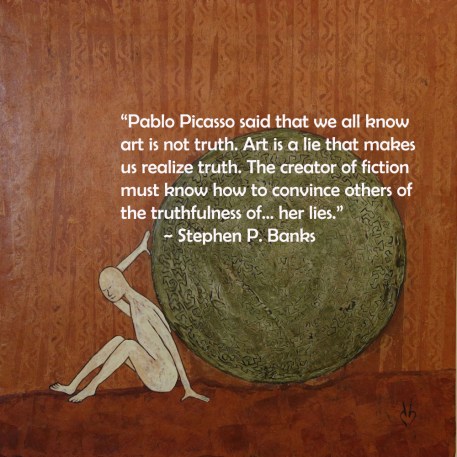
Although I continue to hold a position as Professor Emerita of Anthropology at my former institution, I stopped being actively engaged in anthropology almost a decade ago. Or did I? The further I get beyond that watershed date called “retirement”, the more easily I see the profound influences of social science on my life as it continues to unfold.

Today I decided I needed to look back on a textbook I used for a class I taught on Neanderthals, in which we studied novels about Neanderthals alongside the scientific treatises. The book I pulled off the shelf is called Fiction & Social Research: By Ice or Fire, edited by Anna Banks and Stephen P. Banks.

The introduction the Bankses wrote for that book struck a deep chord with me and may account at least in part for my eventual turn toward fiction writing. They credit Eudora Welty, Nadine Gordimer and Milan Kundera for inspiring them “to think about the nature of truth and the place of fact in storytelling, and the relation of truth and facticity to the imagination.”

Perhaps the most important thing I learned from Anna and Stephen is that “facts don’t always tell the truth, or a truth worth worrying about, and the truth in a good story – its resonance with our felt experience… – sometimes must use imaginary facts.” From them I learned the concept of “verisimilitude”, the notion that a story can have an unmistakable ring of truth even when the “facts” are entirely made up.

So here’s a big “Thank you!” to a couple of social scientists of great imagination and courage who planted in this social scientist the seeds of a late-blooming desire to write stories – completely made-up stories – that have the ring of truth.

Lessons From the Art Studio

SOLD Morning in the Garden of Eden. 18 x 12, acrylic on lokta paper

Almost a year ago, I moved out of my art studio to devote myself full time to writing. Do I miss my studio? Of course I do – wonderful days full of surprise and discovery spent in the company of my beloved handmade papers and amazing colors and mediums. And fellow artists. I miss them, too, although I still go visit them in their own studios (one of which used to be mine).

I learned some important lessons in that art studio, some of which continue to serve me well in my writing. I was reminded of one of those lessons when I saw this quote (posted today by PEN America on Facebook):

“I think the difference between being a person of talent and being a writer is the ability to apply the seat of your pants to the seat of your chair and finish.” ― E.L. Konigsburg

Paintings are statements – images that inspire you in the moment and that you speak onto the canvas (or, in my case, paper) to the best of your ability. But you don’t go on forever rephrasing them. If you do, you will become your own worst obstacle, inhibiting your ability to receive the next inspiration, to make the next statement. If you keep reworking, you may end up with an amazing painting, but there will likely be several more – perhaps equally worthy of having been shared – hidden within it. In painting, there comes a moment when you have to look at a work, wish it well, sign it, and hang it on the wall. Let it speak its piece while you move on to the next thing, attend to the next inspiration.

The same thing holds true in writing. Write the story. Finish it. Polish it just enough. Publish it. Move on. So what if it’s not the whole story? The next one will add its own statement and then also the one after that.

Coming in May: Shadow of the Hare – Book II in The Recall Trilogy! 

Read more from Donna Dechen Birdwell.

This I Believe

"Pursuit of Happiness" 18 x 18

“Pursuit of Happiness” 18 x 18

I believe everyone should run, play games, sing, dance, tell stories, and make poems and create all kinds of amazing objects out of clay and paint and whatever they can find. I believe that we should honor and celebrate those who are especially good at these kinds of things. But we should never discourage those who are more enthusiastic than expert, more passionate than talented, more eager than educated. We reach our full potential not through criticism, but through the sheer pleasure of doing a thing increasingly well.

We have become a nation of spectators and that breaks my heart. Creativity, imagination, and physical exuberance are essential human characteristics and we deprive ourselves of our very humanity whenever we shut these qualities away, experiencing them only second-hand as we watch players on a field, actors on a screen, dancers on a stage, or listen to musicians and singers or read books or gaze at works of art.

So who cares if your paintings are not museum quality? Who cares if you’re not the best player on the court or the best singer in the choir? Who cares if your stories make the bestseller lists or not? Just go out there and enjoy the fullness of your humanity. Critics be damned.

How Do You Feel About Emotion?

"Communication" (Side One) 18 x 14

“Communication” (Side One) 18 x 14

Yesterday I attended a Writers’ League of Texas workshop on “More Than a Feeling: Writing with Emotion” conducted by author Greg Garrett. He shared with us a whole heap of wisdom he said he acquired from his own writing guru Robert Olen Butler at U. Iowa. It was clear that he had verified all of this wisdom personally. Perhaps most importantly, he told us that each of us has within ourselves a “compost heap” of forgotten things that contains every emotion we will ever need to access in our writing. This morning I found his message reinforced by a quote from Brene Brown about vulnerability and the difference between sympathy (a disconnect) and empathy (connection): “Vulnerability isn’t good or bad. It’s not what we call a dark emotion, nor is it always a light, positive experience. Vulnerability is the core of all emotions and feelings. To feel is to be vulnerable. To believe vulnerability is weakness is to believe that feeling is weakness.” And then I started to remember what my Buddhist gurus were trying to teach me about compassion and the necessity of going to “the places that scare you”…

So now I know I need to shed my armor and jump into my own redolent, simmering compost heap and return to my manuscript for one last heart-wrenching revision. Thank you, Greg!