Recall Trilogy… so it begins!

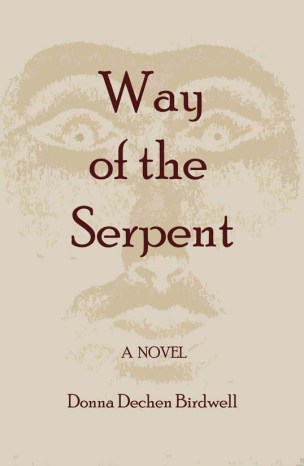
“When Jenda Swain – youthful and vigorous at the age of 111 – encounters an incongruously old woman at an out-of-the-way cafe, her life veers in a new direction amid unsettling questions about her own identity and her role in the corporation-dominated culture of 2125. Her journey takes her into the arms of an activist artist, who has a quest of his own. Answers come together as their world falls apart.”

NEWSLETTERbookcover

Way of the Serpent is available on Amazon.com as either paperback or for Kindle.

Available in Austin at Malvern Books and Bookwoman and in Houston at Brazos Bookstore.

Book II – Shadow of the Hare – set for publication in 2016!


Timely…

Unwinding

(This is a “Tale of the Timecrypters”, a species of time-travelers invented by author Seth Abbot, a character in my upcoming novel, THE FOURTH TIME.) 

The future was already lost. The only hope was to retrieve their past, reposition it, and hope for the best. They would eventually be known as “Timecrypters”. They knew this, but preferred to call themselves “Travelers”.

The scenario in which they found themselves was occurring in what the carbon-based alpha species of this rather pretty blue-green planet referred to as the year 2015 CE. Travelers tried to make note of these timeposts, as otherwise they were inclined to forget where or when they had been coming from as well as where or when they were going. It was easy to get caught up in scenarios, these convoluted meanderings of present circumstances laden with residues of past occurrences and hints at future possibilities. As noted, these hints had recently faded away into absence.

It should perhaps be confessed that the narrator of this story is also a Traveler, but since Travelers have no native linguistic equivalent of first person pronouns, it is easier for them to relate this story as a third-person tale. Verb tenses are also problematic, but they will have done their best.

The expertise of Travelers – Timecrypters, as you say – lies in their ability to navigate the currents of the time-space continuum by accessing small breaches between eras and universes. And when they say “small” they mean really minutely tiny. So tiny, that they can’t actually move through the breaches themselves, sending instead nano-robots equipped with photonic projectors and holistic transmitters, by means of which they can manifest whatever forms seem spatio-temporally appropriate and then projecting their consciousness into that form. Because they are not just communicating with these forms but rather BECOMING the form, they sometimes forget, as it were, which when they’re in and become more involved than perhaps they should have been in specific scenarios. It is always being a risk of this particular mode of travel.

The prime movers in the scenario related here appeared to be energy and moisture and the changing distribution of these across the blue-green planet’s surface. Ah yes, mundane, mundane. Exactly. The most fundamental facts so often appear mundane to those who exist by means of them. Have you ever tried to explain water to a fish? Don’t bother. They don’t get it. Likewise the alpha species of this blue-green planet, a terrestrial species, didn’t get their own reliance on the time-currents that distributed energy and moisture for their sustenance.

There were more proximate factors in the scenario, namely Mario Verguenza – the richest specimen on the planet in terms of the things the alpha species valued most – and Gandida Raksha, who exemplified their highest ideals of personal beauty and sexual desirability.

The lifeways of the planet at this juncture in the scenario were facilitated by means of energy that was having been mined from below the surface, where is storing over many eons. Of course it all comes first from their star – a rather unremarkable mid-sized star – and was having been being transformed into physical form by an exceptionally efficient and truly admirable process they called photosynthesis. The photosynthesizers carried much of this fixed energy to their graves, where it was stored and was now extracted for use.

Rather than ingesting this stored energy for direct benefit, however, the creatures of this planet had taken to burning it in various inefficient and wasteful contraptions to produce a wide range of goods that, as far as Travelers could see, had no benefit. They also consumed a lot of it in simply scurrying as rapidly as possible from one place to another. As a byproduct of these activities, the efficacious balance of energy and moisture transfer essential to their life processes was being severely – no, terminally – disrupted.

They didn’t really care about this, even in the fleeting moments when they almost understood. Among those most notable for not caring were Mario Verguenza and Gandida Raksha. They reveled in the reckless accumulation of useless goods and scurried from place to place more than most.

The Travelers were having produced a particularly endearing photonic small canine, which Gandida had quickly adopted and carried with her everywhere. They also produced a specimen of an unobtrusive variety of small brown bird, free to fly about and observe more broadly.

It became obvious to the Travelers that Mario was bent on extracting and incinerating every last ounce of stored energy from the planet. They felt the quivering disruptions in the continuum. They sensed the disappearance of the future.

During the late nights when Mario and Gandida were engaged in non-reproductive sexual activity and early mornings when they slept, the lapdog and the little brown bird convened to compare notes.

“It is palpable,” the little bird said. “These people have consumed their future.”

“Shouldn’t there have been some doing to help?” asked the dog.

“It’s so hard not to get involved,” the bird replied, with a sad, down-drifting twitter.

“If Travelers could have gone back to where this scenario began, to see if it might be tweaked? Just a little bit, understand…” The dog rested its head languidly on a paw and twitched an ear.

And suddenly they were inside a building where metal objects with four wheels were assembled. The term “Model T” comes to mind. The Travelers were taken the form of cockroaches skittering about in the corners of the factory, and as they look at the heavy boots of the workmen, they felt the vulnerability of this particular form choice.

“Is this where it started?” one of the cockroaches said.

“Unlikely,” said the other.

The scene shifts again, and they were in a beautifully appointed sitting room. There are chairs of carved mahogany, upholstered in intricate tapestries. Heavy brocade curtains hang at the windows and brass ornaments gleam in the light of a blazing fireplace. A corpulent gentleman sat on one of the chairs, smoking a cigar, while a gentlewoman in rustling silk sipped tea or coffee from a delicate porcelain cup held in a hand sparkling with jeweled golden rings. The Travelers occupy the forms two of mice hiding behind the wainscoting.

“Can you feel it?” said one mouse, its whiskers quivering with excitement.

“Yes, it manifested strongly here,” the other replied. “This is where the future begins to disappear. But what is it that was happening?”

They both sat very still for a couple of minutes, training ears and whiskers this way and that to get a better read on the time currents flowing through this scenario.

“It’s the desire, isn’t it?” said one.

The other twitched its nose in agreement. “Even so,” it said at last. “The desire for objects, things, experiences of faraway places. Maybe the desire to feel exalted? Outside this space there is readable a similar desire to have what is in this room. And of course, there can never be enough for that.”

“Is there anything that can have been done about it? You know, to prevent what transpires from here and consumed the future?”

“Maybe it’s just the way they are,” the second mouse suggested. “Maybe they were simply destined to be a species with no future.”

“You know that’s not the way things work,” the first mouse scolded. “There’s no such thing as destiny. You’re absorbing their way of thinking. Get hold of yourself.”

The second mouse scratched its head with its back foot. “Sorry,” it said.

The first mouse closed its eyes thoughtfully. “What if these ones had never acquired these things? What if they had to rely more on things from their own place? You know, their own resources?”

The second mouse perked up its ears. “Maybe if their temporality had been shifted somehow. Grabbing a piece of the past and repositioning it in such a way as to give them a chance to have emerged in a different way.”

The scene changes once more and they are on a ship at sea. They are no longer mice, but instead rather large and nasty rats, gnawing vigorously at some thick ropes. The ship lurches side to side, backward and forward in a dreadful tempest. The wind howls and waves smack loudly against the timber hull. The ropes the rats have gnawed through give way. A mast cracks and then crashes onto the deck, smashing a hole where water enters. The two rats climb onto a piece of floating debris as the ship disintegrates. And because they are really Travelers and not rats at all, they can read the names inscribed on the disintegrating hull of this ship and two others equally doomed – Niña, Pinta, Santa Maria. There are sailors flailing about in the storm-tossed waters, desperately clinging to anything still afloat.

As dawn breaks, broken bits of wood, a few empty barrels, and a couple of corpses bob aimlessly in the calm waters.

On the time horizon, the future glimmers.
This I Believe

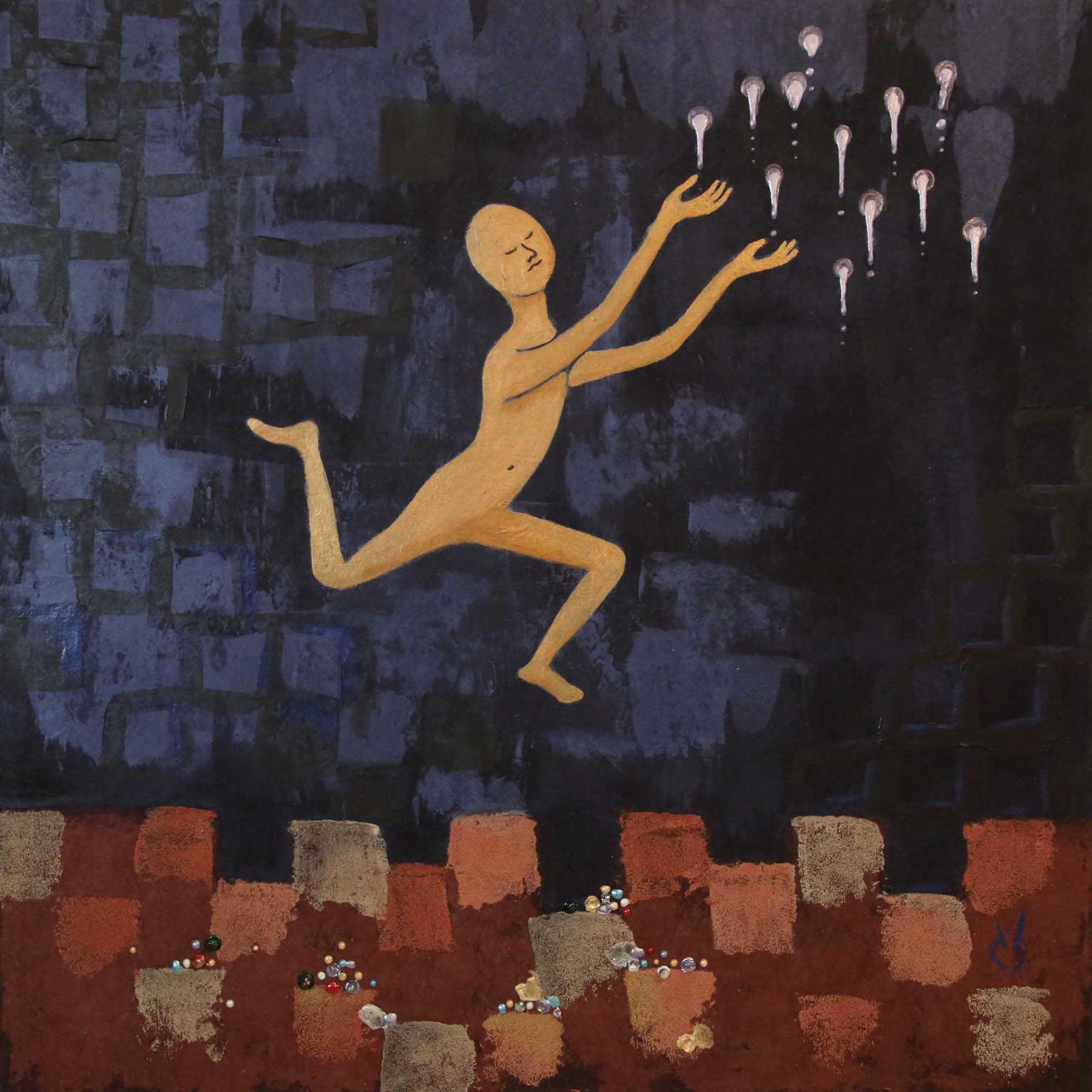
"Pursuit of Happiness" 18 x 18

“Pursuit of Happiness” 18 x 18

I believe everyone should run, play games, sing, dance, tell stories, and make poems and create all kinds of amazing objects out of clay and paint and whatever they can find. I believe that we should honor and celebrate those who are especially good at these kinds of things. But we should never discourage those who are more enthusiastic than expert, more passionate than talented, more eager than educated. We reach our full potential not through criticism, but through the sheer pleasure of doing a thing increasingly well.

We have become a nation of spectators and that breaks my heart. Creativity, imagination, and physical exuberance are essential human characteristics and we deprive ourselves of our very humanity whenever we shut these qualities away, experiencing them only second-hand as we watch players on a field, actors on a screen, dancers on a stage, or listen to musicians and singers or read books or gaze at works of art.

So who cares if your paintings are not museum quality? Who cares if you’re not the best player on the court or the best singer in the choir? Who cares if your stories make the bestseller lists or not? Just go out there and enjoy the fullness of your humanity. Critics be damned.

Sisters

FullSizeRender 2

When she smiles,
You forget all about the lazy blue eye
That seems to search for something the rest of us
Never notice.
When she laughs,
You don’t see the postmenopausal whiskers
On her chin.
Her awkward gait is fine
As she strides to the front walk
Where she spreads food
For homeless cats.
She likes books with pictures –
Shirley Temple, Johnny Cash, Princess Di.
Words are difficult.

Her older sister orders for her at the pancake house.
Later, they stand together
In the edge of the surf
Remembering the same beach, years ago,
When Mom and Dad took them there to play,
Long before worries of work or elusive pin numbers
Or rent or keeping an old car running
Overtook their lives.

The older sister’s square shoulders carry them.
The sister with the lazy eye has sloping shoulders.
She pays her way with smiles
And laughter.

The Blues

THEBluesIMG_6324

There’s a place at the intersection
Of sadness and consummate joy
Called “the blues.”
I’ve built a house there,
a house I don’t live in.
I spend most of my time
Up one street or
Down the other.

I’ve tried painting other rooms
In other houses
With the brush
Used on my corner house,
But I never seem to get it right –
Always a little too bright or
A little too somber.

My house at the corner
Is always full of musicians
(or their music, after they’ve moved on)
And poets.
The occasional novelist passes through.
A few artists have left paintings there.

I feel more alive in this house
Than anywhere else.
Even when I’m alone.
Even when there’s a crowd of friends
And strangers.
Everybody’s welcome here.

(This poem needs another line or two for resolution,
But there is no resolution
For the blues.)

On Waller Creek

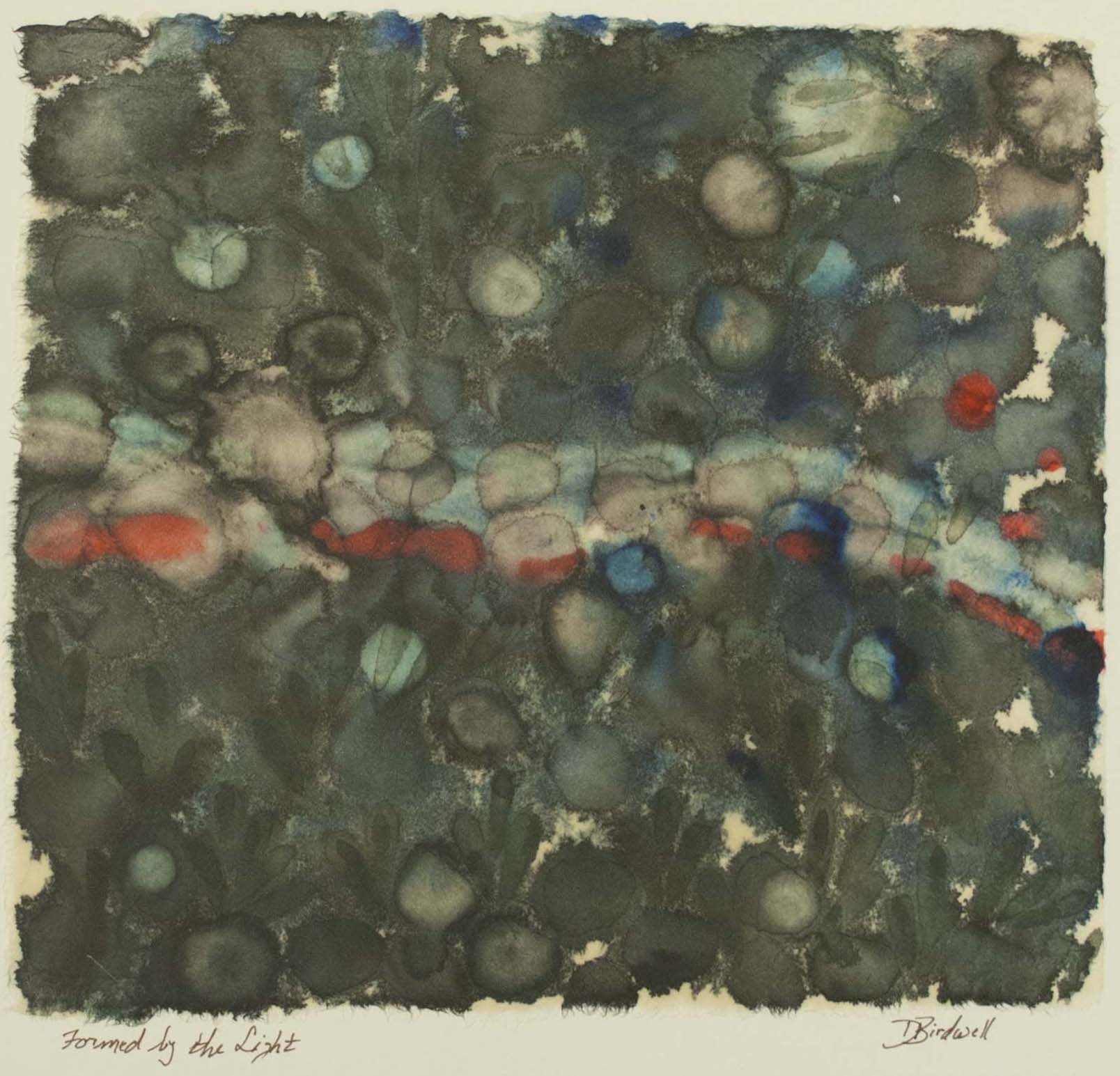
SOLD Formed by the Light. 11 x 14, acrylic on lokta paper

From the broken place in the retaining wall
I can see where the rains
Formed a rivulet
Leading down to where the water
Always flows
Even when the rains never come.
The flow moves on through still, deep places,
Through playful shallows,
Down to the lake where my friend
Walks his dog at sunrise.
Over the dam, it’s a river again
(as it always was, underneath)
Flowing on its meandering course,
Crossed by repeating bridges,
Onward to the sea where another friend
Walks her dog along the beach at sunset.
And out on the far shore of the same sea
(it’s always the same sea)
Another friend repairs a wall
Broken by a recent flood.

Madness, I Tell You!

The Mad Hatter's New Hat

“Are you mad?” she demanded. “Have you completely lost it? Helloooo!”

I listened carefully. I’d always wondered exactly what this thing we call madness might really be. Maybe she would explain it to me. I was increasingly convinced that either I or everyone else was hopelessly mad, although I couldn’t tell which it was. Maybe if I had a better understanding of madness, I’d be able to decide.

I’d done some research.

The word “mad” occurs in my dictionary between the words “macule” and “Madagascar”. A “macule” (or “mackle”) is a printer’s term referring to “a spot, especially a blurred or double impression caused by a slipping of the type or a wrinkle in the paper.” I thought this might be a clue.

Madagascar, of course (formerly Malagasy Republic), is a large island off the southeastern coast of the African continent that I knew from my anthropological studies to be home to a collection of rather prehistoric primates long since extinct on the continent where monkeys and apes evolved and prevailed. Madagascar has no monkeys or apes – except for Homo sapiens, an invasive species. It does have dozens of species of lemurs as well as the exceptional sifaka, which moves by means of sidewise leaping. I thought this could be a clue as well.

To be mad, I thought, is like being caught somewhere between a blurred line on wrinkled paper and a sidewise leaping primate.

Etymologically, the word itself – “mad” – derives from the Old English gemaedde, meaning “out of one’s mind”. This evolved in Middle English into a meaning of being “beside oneself.”

As a student of Buddhist meditation, I find this intriguing. One of the goals of meditation is to be able to observe dispassionately and objectively one’s own thoughts and feelings. In other words, I suppose, we could say, to take up a position outside of one’s mind, as it were, or beside oneself as opposed to remaining hopelessly embedded and ensnared in one’s thoughts and emotions.

Interesting.

Is that madness?

Apparently so.

To be “mad” can also imply anger, although I don’t think that’s what my friend meant. I knew her usual term for that was “pissed off”. It’s true that anger can drive one mad. Also other people…

Then there is the question of rabies and rabid, “mad” dogs. Which brings up the altogether puzzling question of mad dogs, Englishmen, and midday sun, which, to be perfectly frank, the English have very little experience of.

There is something I recall about being far from the madding crowd, which often sounds enticing. And some seductive notion of a kind of “madness” that is liberating and wild and impetuous.

“Hello!” she said again. “You’ve really lost it this time! Gone off the deep end. Gone ‘round the bend. Mad as a hatter!”

“Do you know why hatters are mad?” I asked. “It’s because of the mercury they used in the production of the felt for the hats. Mercury poisoning,” I said.

She shook her head in despair. “You’re mad,” she said again. “You’re absolutely stark raving mad.”

“Did you know that the term ‘stark raving mad’ first appeared in Henry Fielding’s The Intriguing Chambermaid in 1734? But yes,” I said at last. I sighed deeply. “Yes, I believe I am mad. Would you care to join me?”

(This piece was originally presented at Austin Writers Roulette “Spark of Madness” on Sunday, September 13, 2015.)

Report From the Writer’s Desk

IMG_1059

It’s been a busy six weeks! My last post was about the Texas Writers’ League conference at the end of June. From there I headed off to Belize to revise the first half of my next novel – THE FOURTH TIME – in the environment where the story takes place. Arriving back home, I finished that round of revisions and have now sent the manuscript out to three beta reviewers for critical comment. While I wait to hear from them, I continue writing the first draft of FLIGHT OF THE OWL, which is the sequel to WAY OF THE SERPENT. I am now a bit more than 40,000 words into that one and – so exciting! – I know how it ends. At least, I think I do!

WAY OF THE SERPENT is now available at two local independent bookstores – Bookwoman on North Lamar and Malvern Books on West 29th Street.

I got my first check from my print-on-demand paperback publisher, CreateSpace, and it looks like my book is doing pretty well on Kindle. I only have three Amazon reviews so far, but all three make me smile.

Today I’m headed off to another fun afternoon of Austin Writers’ Roulette with the incomparable Teresa Roberson, where I’ll be reading a piece of flash fiction, “A Tale of the Timecrypters.” (I’ll tell you a secret: The Timecrypters were dreamed up by the sci-fi novelist husband of my protagonist in THE FOURTH TIME. This is the only story he’s shared with me so far!)

Thursday evening at 7, I’m doing “Novel Night” at Malvern Books, reading from WAY OF THE SERPENT and answering questions from the audience. I’ll be sharing the stage with Steven Metze, author of THE ZOMBIE MONOLOGUES.

Final note:  Just for fun, I placed a copy of WAY OF THE SERPENT in one of those little roadside lending libraries in my neighborhood. I dedicated it to “my Hyde Park neighbors”, signed it, and asked that it be shared forward. I also circled my email address in the back. It would be so excellent to hear from someone who reads this copy of my book!

Writers’ Conference Takeaway

"Overwhelmed" 18 x 18

“Overwhelmed” 18 x 18

I spent the past weekend immersed in a rather wonderful “agents and editors conference” put on by   Writers’ League of Texas   in Austin.  I’m a newcomer to this whole writing and publishing game, so I was eager to learn, excited about pitching to an agent face-to-face, curious to see what other writers are up to and what they have to say about what we do. I was looking for insight on how to plot my course forward as I nurture my first self-published novel and ready the next one for its eventual debut in print.

Here is what I think I learned from my colleagues and the gatekeepers of our profession:

Although there are many paths forward, there seem to be two disparate directions the novice writer might take. One I would call the “path of honor”. This path is pursued by submitting material for contests and literary journals, striving to accrue accolades from the anointed and an eventual place within a “big house”. The other is the “path of material reward” – marketing the hell out of deliberately marketable stories and raking in the dollars from an adoring public, keeping them salivating for more. However much we wish to believe in a convergence of these paths, it’s rare. Exceptionally rare. I met successful and talented writers on both trajectories and I maintain deep respect for their personal choices, diligence, artistry, and generosity in sharing stories from their respective paths.

I’m not sure either of these distinct directions is for me. I’m an independent at heart, happiest when I’m doing my own thing. I don’t care much for either accolades or material reward. I want readers. I want to reach people who want to think about and talk about the things my stories are about. And I believe stories always have to be about more than a sequence of events. As an artist, I finally had to accept the label of “conceptual artist”, however uncool that may be. I’m also a conceptual writer.

I come away from the conference still uncertain of my path forward. If I found the “right” agent, could I be happy on that path? If I could tap into and inspire the “right” audience, would I be willing to market to them in order to keep them as fans?

TO BE CONTINUED…

Art and Memory

Things Remembered, 20 x 16, $450

Things Remembered, 20 x 16, $450

My protagonist in WAY OF THE SERPENT falls in love with an artist – Luis-Martín Zenobia – who was educated as an anthropologist. Here is what he wrote about art and memory:

Time was when memory existed solely in the minds of men and women, and the elders of the society were its treasury. As humankind evolved, art became the handmaiden of memory, encoding in images – and in stories that were recited or sung or danced – the episodes and values that defined a people. Writing was the next revolution of memory. The printing press was another. Digital electronic storage took memory to the next level but also put it at risk as never before. In every age, people believed their encoded memories to be somehow infallible, unassailable, invulnerable. They were always wrong, but the notion was pervasive and reassuring. It still is.

READ MORE – Available on Amazon or at Bookwoman in Austin, Texas.