Time & Magic

“Time exists so that everything doesn’t happen at once and space exists so that everything doesn’t happen in the same place.” — Albert Einstein (allegedly…)
 

This quote showed up in my Facebook “memories” today. It was fortuitous, since I had already typed in the title of this post…


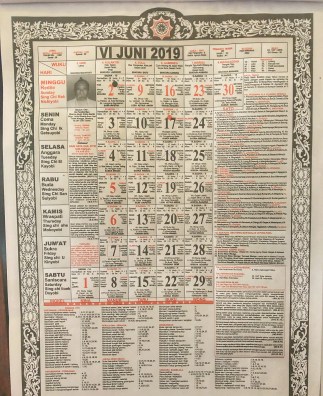
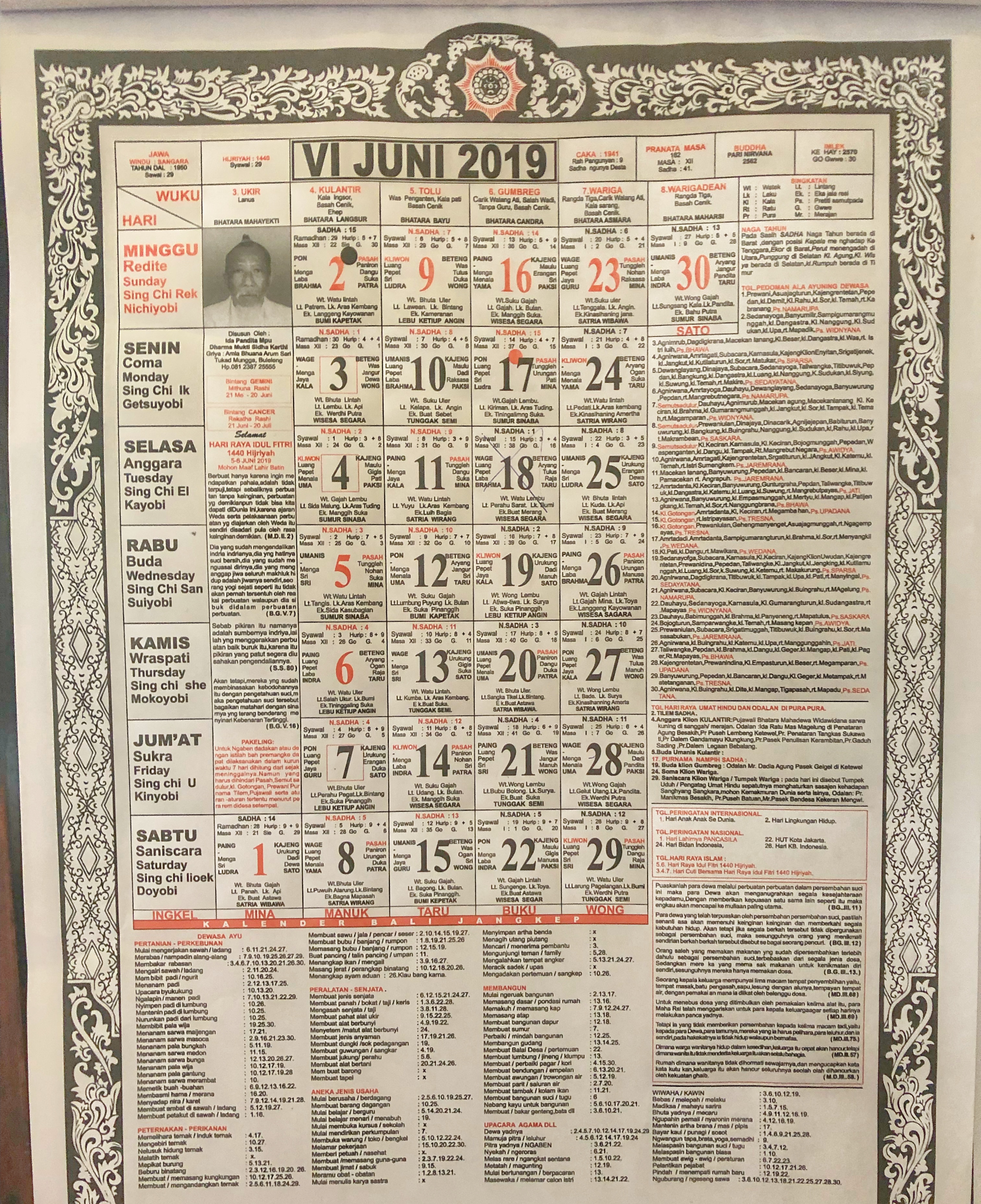
Bali (the space I currently occupy) invites reflections on time. In Bali, you see, there are three calendars running simultaneously – our standard Gregorian calendar is one; the 210-day calendar called Pawukon is another; and the third is the Saka lunar calendar.

The Pawukon is not so much a “year” as a cycle, “since no record is kept of successive ‘years,’ nor are they numbered or named. They just pass by.” The Pawukon is organized into ten different systems of weeks, from a one-day week to a ten-day week. Most important are the three-day, five-day, and seven-day weeks. All these different “weekdays” have names and the conjunctions of these myriad cycles is important in differentiating auspicious days from inauspicious ones for all kinds of activities.

In my new book (coming July 20), “time” is an important subtext to the story. Meg is an archaeologist, obsessed with the past. Her husband Seth is a science fiction author, writing about time travel and the future. So, yes, the subject of time comes up in their world. Here’s a brief example, in which they’re discussing an impasse in Seth’s WIP. Meg speaks:

“Are you sure they’re not inter­fering with the timeline?” (Would I mind so much if they were?)

“Well, there’s another aspect of the story I’m still work­ing on.” Seth scratched the back of his neck and frowned. “Maybe time isn’t a line…” 

You may now pre-order the Kindle version of NOT KNOWING and it will be sent to you on July 20!

(Quotes about Balinese time are from Fred Eiseman, Jr., BALI: SEKALA & NISKALA.)

Flow

I woke up this morning thinking about flow, about how awareness of flow, synchronization with flow, has been so important to life on our planet. Flow is profoundly present in cultures like the Balinese – the flow of water, the flow of light-energy (east/west), the flow of winds, the lunar flow of tides. We are water beings, light beings, wind beings. How have we in the modern West become so immured to flow?

So many sacred places around the world have to do with water (sacred springs, streams, rivers), or with the energy of celestial movement, with high places and low, with crossroads and confluence. The Balinese are deeply sensitive to their orientation within the flows in their world. Everything is kaja (toward Mount Agung – the active volcano that is the highest point on the island) or kelod (away from Agung) and concurrently kangin (east) or kauh (west). I want to know how it would feel to be like that, to be satisfied that I know where I am without Siri or Google Maps. To know which way is up, how the water and earth and heavens move (and me in it) and for that to be enough. Instead I often feel like a fish trapped in an overcrowded and stagnant pond, waiting to be fed.

Like Meg in my novel, I am sometimes troubled by what people call “magic.” This isn’t magic. It’s just flow. It’s real. It’s possible. It’s everywhere.


Summertime


Happy summer solstice!

I know my friends in Texas think summer began weeks ago, but my tropical island nest here in Bali is treating me to such mild weather it’s hard to remember the 100 degrees in Austin earlier this month!

What I’m enjoying is also a very different tropical June from the one experienced by my main character, Meg Fitzellen, in my soon-to-be-released novel entitled NOT KNOWING. Meg is an archaeologist and every summer she heads for “the field” to dig and discover. Her archaeological site is Kawilkan in northern Belize, an area I know well from my own fieldwork, which began in the 1970s (and may still be ongoing)! The last time I was in Belize I was working on this very book at a resort near Belmopan LINK. That resort has kind of worked its way into my novel under a different name and with a few other changes.

In the book, Meg’s summer is not turning out the way she planned. As she observes on page 139, “Apparently, this summer was destined to push all my buttons. I’d just been reminded yet again of how dangerous it could be to have firearms in camp, reminded of exactly why I’d instituted my strict rule of no firearms in the first place. Dr. Fitzellen’s rule was no fire­arms. No firearms and no weed. No exceptions.”

Here’s hoping our summers turn out better than Meg’s! Mine is already downright epic!

You can now pre-order the Kindle version of NOT KNOWING and it will be sent to you on July 20!

The Journey Continues

FullSizeRender 8

I’m back at my home base in Austin, Texas, after a week on the road and a journey of a couple thousand miles. I traveled on, undaunted by small inconveniences like having some dude in Lebanon (yes, the country of Lebanon) try to use my credit card on the third day of my travels, resulting in the card being cancelled and me being left with only my bank card and cash on hand. Undaunted, as well, by another dude, the one driving the white Lexus, who failed to stop soon enough and plowed into the back of my car exiting off I-30 in Fort Worth.

Never mind those things. It was an amazing trip. There were vast expanses of geologic time strewn out before me, forcing me to imagine ancient seas, volcanic eruptions, eons of uplift and erosion. There were people whose experience and narrative of American history is vastly different from my own, people with gentle manners and firm rules: no photography, no recording. They told me what I needed to know. They expected me to remember it, and I’m sure I will.

My bedtime reading last night delved back into Marilynne Robinson’s Gilead, the passage where the preacher protagonist reflects on a wartime sermon he never preached. “The parents of these young soldiers would come to me and ask me how the Lord could allow such a thing. I felt like asking them what the Lord would have to do to tell us He didn’t allow something. But instead I would comfort them by saying we would never know what their young men had been spared.”

My own journey through life continues and I remain undaunted by small miseries. Who knows what suffering could have been my lot if I weren’t so fortunate? Happy travels!

Exploring Hopi Country

IMG_2538

I came to Arizona in search of deeper insight into one of the characters you will meet in Vol. III of the Recall Chronicles. Her name is Dextra and she is a Hopi woman. Since my arrival here on Second Mesa yesterday afternoon, I have held wide-ranging conversations with a half dozen real Hopi women, asking them questions and listening to them muse about what life might be like for a woman in the Hopi world in the 22nd Century. Through them, I’ve come to know Dextra much more fully. I’ll have to rewrite several scenes and conversations, but that’s okay; that was what I hoped would come from this journey.

I don’t want to tell you too much about Dextra. Just know that she’s waiting to meet you in a book called Flight of the Owl. I will, however, share with you a few tidbits of information that came my way today.

  • Some Hopi believe that owls are protectors, while others see them as messengers, possibly of bad news.
  • There is a wild plant on the mesas that bears tiny, tiny green leaves that taste like mint. Only stronger.
  • Dogs are protected beings among the Hopi (which explains why this is the only area on my journey where I’ve seen dogs!). I was told that sometimes Navaho people will drop off litters of puppies at Hopi shops, knowing the dogs will be well cared for.

Have you read Vol. I – Way of the Serpent?

Respect

OWLfeather4blog

As I prepare to set off on a journey to Arizona to contextualize the Hopi character of Dextra Honanie (Recall Chronicles, Vol. III – Flight of the Owl), I must take heed of J.K. Rowling’s current tribulations in Pottermore.

Rowling is in process of attempting to construct a bridge between the world of Harry Potter and “magic in North America”.  Adrienne Keene, in her blog “Native Appropriations”, takes Rowling to task for several transgressions, beginning with the reification of something called “Native Americans”. Keene rightfully points out that this is a broad and diverse cultural category, encompassing as it does Inuit, Apache, Hopi, Iroquois, Navaho, Cherokee, and many other equally distinctive societies.

Rowling also gets into some awkward attempts to intertwine the fictional world of wizardry with some real events in American history. I fully understand the temptation of providing a Potteresque slant on the Salem witch trials, but I’m mystified by Rowling’s statement that the Magical Congress of the United States of America (MACUSA) was founded in 1693, a full 83 years before the founding of the United States of America itself. Magic, I guess.

One of the most charming features of Rowling’s marvelous world of wizardry has always been its existence as a world apart from specific time and place, a world exemplified – to my mind at least – by Platform Nine and Three-Quarters. Trying to link up with history and a named continent full of real people with complex, still vibrant cultures kind of messes with the magic.

My own fictional world in The Recall Chronicles is clearly linked to real places and potentially real times. And that is why I want very much to get my Hopi character right, or at least plausible enough to be acceptable to Hopi readers. I’m looking forward to my adventures in Arizona!

(More musings on fiction, fantasy, and the real world are in the works.)

Way of the Serpent is speculative fiction.

Where Are You From?

"Trying To Blend In" 8 x 10 framed, $300

“Trying To Blend In” 8 x 10 framed, $300

My collegiate study abroad was the summer of 1969 at the University of Graz, Austria. There I met two women – mother and daughter – and when I asked them that time-worn, tedious question “Where are you from?” they looked confused. I believe they were originally from Bulgaria, but due to politics and undisclosed personal matters, they were officially stateless, traveling around Europe on United Nations passports.

“How marvelous!” I thought at the time. “How liberating to not be tethered to one country and one identity, to be free to move about the world unburdened by someone else’s prejudices about your origins!” I didn’t discuss this with the mother and daughter, though now I fervently wish I had.

I’ve developed some new perspective on this question of stateless persons over the years and especially during the past year as I’ve watched political turmoil and violence turning people loose in the world with nowhere to go, nowhere to belong, nowhere to call home. We call them refugees or, more politely, migrants.

The world appears to be increasingly full of such people, the effluent of conflict and economic catastrophe. Just yesterday I read an article about Nepal, where children born of a Nepali mother and a foreign father cannot claim Nepali citizenship except through a difficult and highly uncertain political process. Without their official citizenship certificates these people “cannot vote, open a bank account, sit for many official examinations, register the birth of a child, buy or sell property, get a passport, or even obtain a mobile SIM card.” They are effectively stateless persons.

Instead of loosening the restrictions of social and political participation, we appear to be getting more and more chary about according citizenship and belonging to our fellow human beings. My youthful infatuation with the notion of global citizenship, one planetary society, was naïve. Although we may be annoyed when people ask the question, we all want to be from somewhere that loves us.

Read more from Donna Dechen Birdwell.

Thresholds

image

Today I am thinking about thresholds – but not physical doorways, gateways, borders, or frontiers. No, I am thinking of thresholds we use to mark the passage of time. Last night I watched a stunning sunset on Playa Tamarindo, and this morning I rose early and made my way to the playa in the dark in order to watch the full moon set over the same waters, just as the sun was beginning to peek above the eastern horizon. It was an unforgettable spectacle.

Ursula Le Guin writes, “A frontier has two sides. It is an interface, a threshold, a liminal site, with all the danger and promise of liminality.” I find the thresholds between day and night, between the presence and absence of the moon, equally infused with danger and promise. And yet in this case the promise lies in the confidence that this is a cycle that will repeat itself. After night, day will come again. The moon, too, will reappear in the eastern sky. And as it wanes into a mere sliver, I know that it will grow again to the bright disk of light I saw in the sky this morning. The tides that made the beach so broad, will soon make it a mere narrow strip.

What we remark most, what we find most enchanting, are the markers, the thresholds we impose on time – sunrise, sunset; the full moon and new moon. In fact, the sun holds its place while our planet slowly, regularly, turns on its slightly off-kilter axis. Likewise, the moon circles our little planet on its regular path, unconcerned with which portions of the globe currently enjoy its soft, reflected light.

It’s all a matter of perception.

Reporting From Tamarindo

image

Reporting from Tamarindo BLOG 02/02 Eating my beautiful breakfast this morning (papaya, pineapple, watermelon, rice-and-beans, plantain, camote pudding) looking out at the beautiful Pacific Ocean… I found myself craving solitude. The breakfast was great, the view was amazing – but the hotel cafe was huge and crowded with noisy guests, ready to head off in a hundred different directions in pursuit of whatever they felt worthy of their time and effort. “I could go back to my room,” I thought. My room is at the very back corner of the hotel, where huge mango trees conceal more than a few howler monkeys. I hear them, but I’ve only seen one. I also saw a really big iguana! But no… I wasn’t looking for isolation. Just solitude. Just a place where I could feel happy to be alone. Well… I found my place. It’s called Cafe Tico and it has outdoor seating under a guanacaste tree. It has iced soy lattes. And it’s right in front of a bookstore, which will open in 15 minutes.

Arrived in Costa Rica!


image

I love being in places that resist being tamed – places with mountains, sea coasts, jungles. Costa Rica has all of these things. It also has hotels, like the one I spent the night in, where a space has been appropriated and domesticated for human use. I hear the call of wild birds as well as the crow of a rooster, from somewhere in one of the simple shacks that line the chain link fence behind our hotel. And there is a noticia on the back of our door about what to do in case of earthquake. I am looking forward to standing at the edge of the Pacific Ocean in a few hours’ time!