Where??

A question people often ask about a book is “where does the story take place?” In the case of the two novels in The Resistance, the answer is about as complicated as you might expect from an author who is also an anthropologist. 

Both stories start off in Dallas, Texas, and they keep coming back there, too. 

Jenda Swain’s story in Way of the Serpent takes her to San Miguel de Allende, Mexico; Buenos Aires, Argentina; and somewhere in Costa Rica. There are also trips to Houston and San Antonio a remote village in New Mexico. 

Malia Poole’s story in Shadow of the Hare spends a lot of time in Philadelphia, Pennsylvania, and Marfa, Texas, but she also travels to Lagos, Nigeria, and Jaipur in India’s Rajasthan. 

If you’re yearning to “get away” without getting on an airplane or on the Interstate, why not read a book that takes you there while you sit in your favorite chair sipping your favorite beverage? 

Finding My Great-Uncle

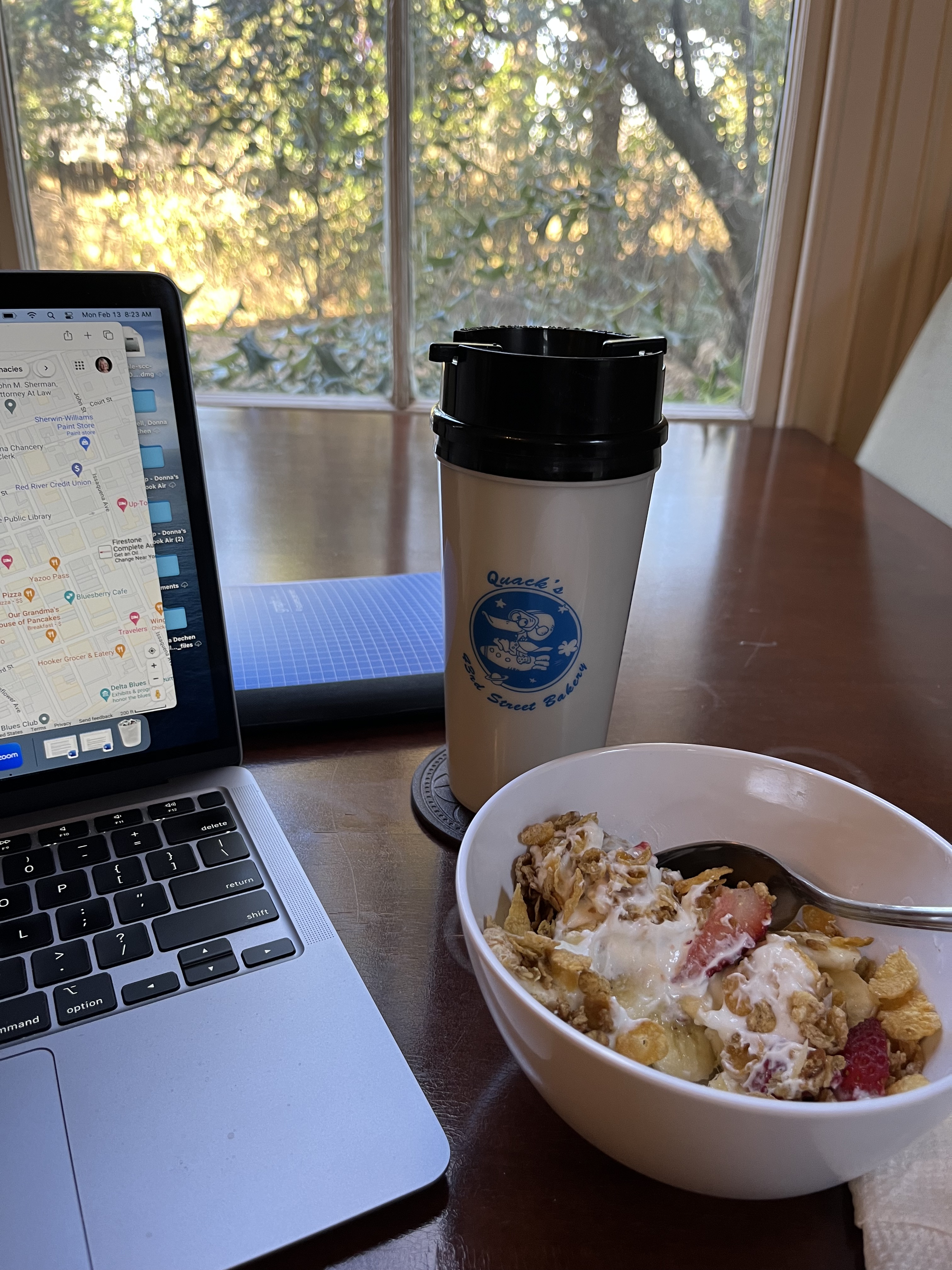
I sit eating my simple breakfast and watch a bird out the window as it hops and flutters from branch to twig and back again. An ordinary little thing, busily following the urges of its feathered kind to eat, stay safe, reproduce. 

We humans have the same urges, except in more complicated form. We’ve turned dining into an art form, an industry, an elaborate set of social rituals. We seek safety not merely from the elements or true predators, but also from concocted and cultivated enemies. Reproduction? Necessary as always for the continuance of the population, but when is the last time we’ve really cared about that? No, we follow the urges—sexual and intimate—for their own sake. When we find an intimate partner whose company we would like to have as a fixture in our lives for the foreseeable future, we may embark on the project of bringing another generation into our circle. Whether we do that via our own sexual act or by adoption or surrogacy seems to matter little these days. However we do it, it results in continuity. The population continues. The species continues. 

Some of us participate in continuity in other ways, choosing or accepting not bringing another generation into our intimate circle, while being useful in other ways to our society and culture, ensuring continuation that nurtures the next generation. 

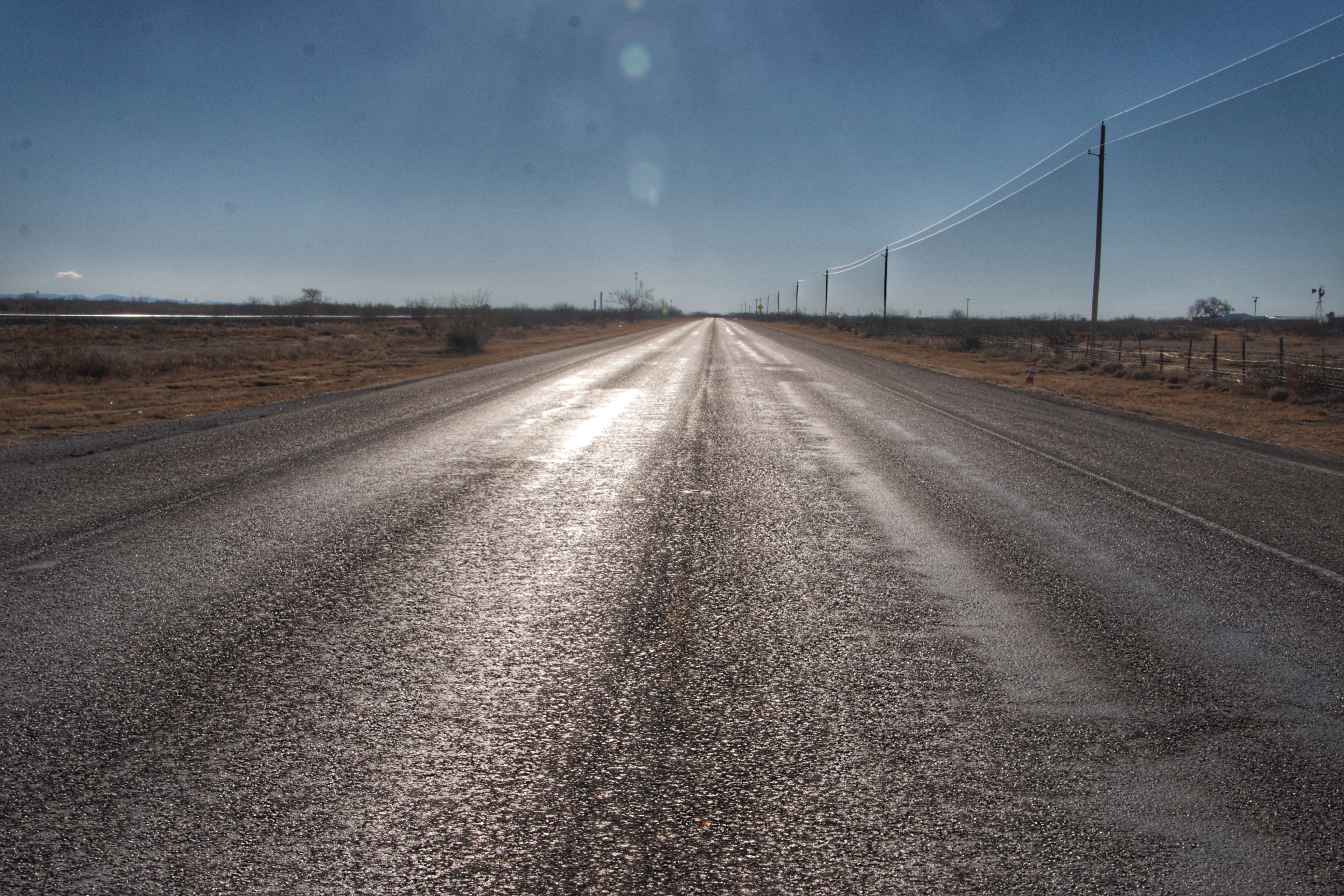
On this road trip, I’ve been driven by the desire to learn more about a particular relative of mine, a great-uncle who never had children, the kind of individual who is almost inevitably neglected by those of us who engage in ancestry projects of various kinds. I’m writing a story, but it won’t be a story about him. It will be a story inspired by what he’s teaching me. I’m almost ready to start writing it. 

Writer Journey Ahead!

My last real “writer journey” was in March of 2016, when I traveled through New Mexico, Arizona, and west Texas collecting interviews and images and impressions for FLIGHT OF THE OWL, book 3 of my Recall Chronicles series. I took a wonderful journey to Ubud, Bali, in June 2019 as I prepared to release my one stand-alone contemporary fiction book—NOT KNOWING. A draft of the first book of my EarthCycles series (SONG OF ALL SONGS) was already in the hands of beta readers at that time, so my trip to Bali was not about researching or writing anything in particular, but rather about settling into a better understanding of who I am as a writer. 

Writing got placed on the back burner at the beginning of 2020 as I temporarily took on a more active role as caregiver for my young granddaughter. 

And then COVID happened. I found that I had lots of time for writing and kept moving ahead slowly despite the daily distractions of politics and pandemic. In the last three years I’ve published three more books: SONG OF ALL SONGS in 2020, BOOK OF ALL TIME in 2021, and BEYOND THE ENDLESS this year. 

Now I’m returning to the Recall Chronicles to write a book four: FINAL RECALL. This story begins exactly where book three—FLIGHT OF THE OWL—left off, with Dextra and Jonathan and Gavin on a plane departing Costa Rica. But whereas Jonathan was the main character in FLIGHT, Gavin is the main character in this one. Major reorientation! They land in Santa Fe, New Mexico. So that’s where I’m going this week. And from there I will trace out the journey Gavin subsequently takes, going south from Santa Fe toward White Sands and then east into Texas. I can’t wait to take my imagination out on the open road!

What Matters

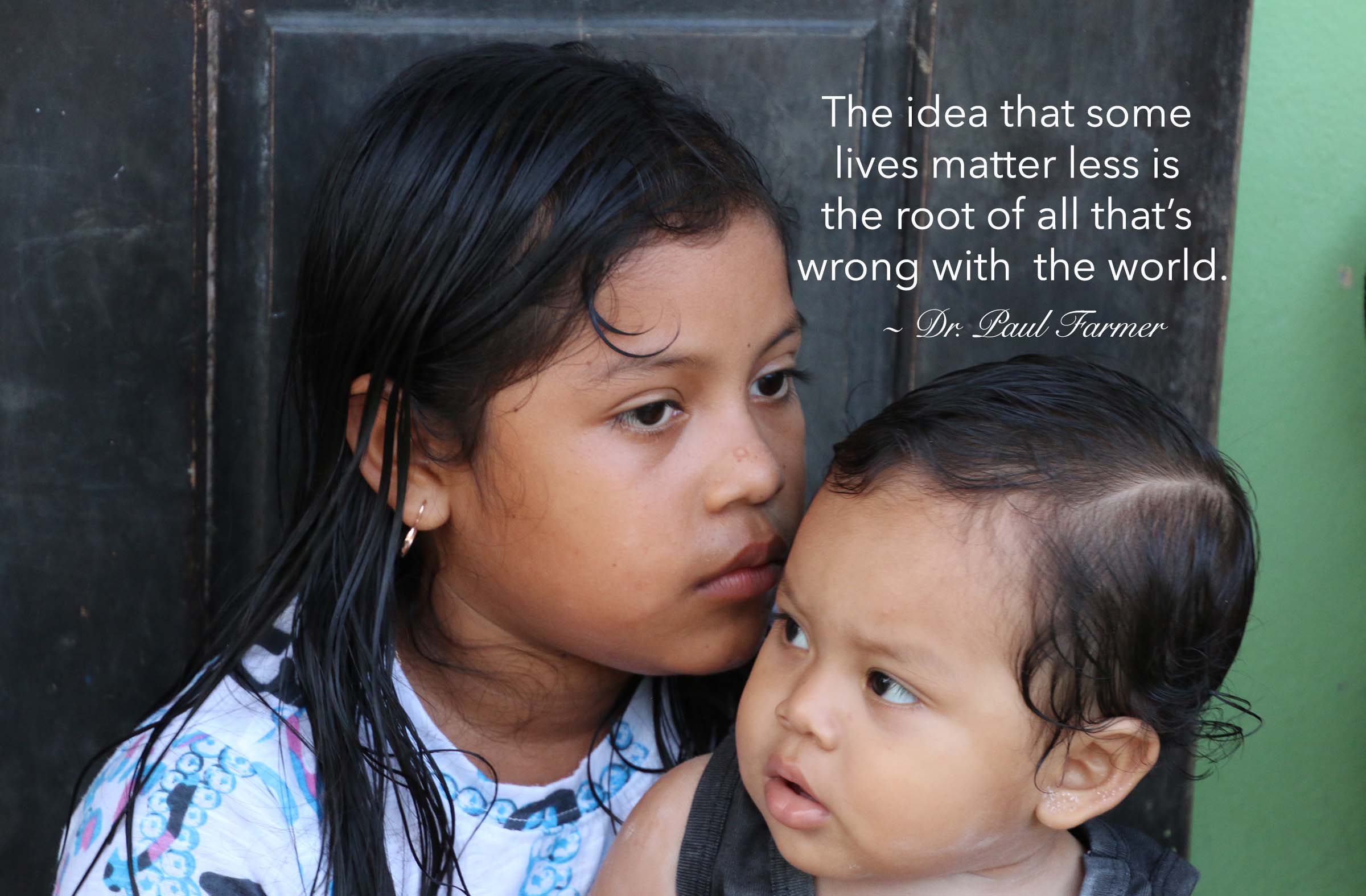
When I look at the news–the spread of COVID-19, the national and global distribution of vaccine, the violence perpetrated against black and brown bodies, the turmoil at our southern border–I can’t help but return time and time again to Dr. Farmer’s enduring truth.

And no, it isn’t just a matter of saying “all lives matter.” We have to own the fact that our world is currently built on the unsustainable premise that some lives matter less. That is what we have to face up to and work to correct.

That’s all I have for today. I’ll let these children’s faces speak the rest of what needs to be said. Please listen with your heart.

A Moment of Magic

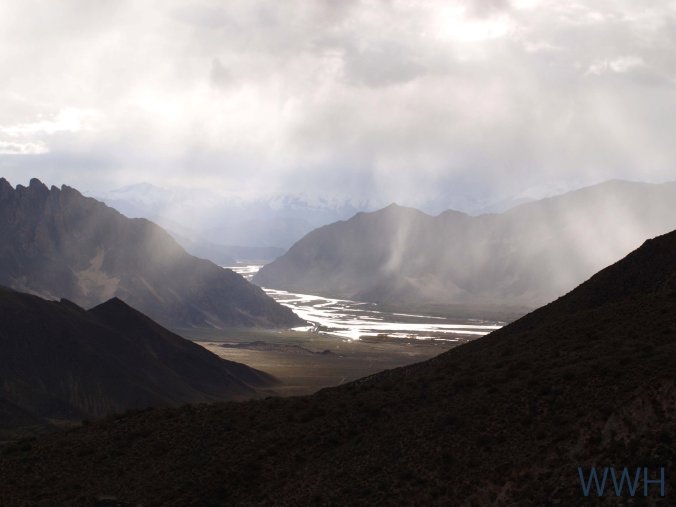
Once in a great while, life offers up moments of unforgettable magic. Facebook gave me this image today and in doing so gave me back a moment of magic from 2010.

The photo looks down from the slopes of Gangri Thökar, on a path leading up to Shugseb Ani Gompa in central Tibet. I was on a pilgrimage with Dechen Yeshe Wangmo and we’d arrived later than we planned at the base of the mountain. A number of our group opted to engage in brief prayers and then head back into Lhasa for a hot supper and welcome rest. The rest of us headed up the mountainside.

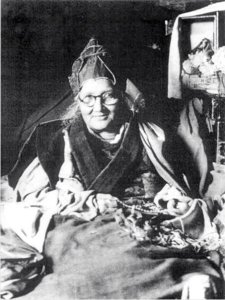
This was one of the pilgrimage sites that had strong personal significance for me. My teacher in Nepal, Khetsun Sangpo Rinpoche, had been a student of an important abbess at Shugseb, the yogini Jetsunma Chönyi Zangmo (1852–1953).

It was late in the day as I made my way up the mountainside, and I soon lagged behind the younger and fitter members of our group, whose destination was a cave near the mountain’s summit associated with one of Tibet’s most revered scholars, Longchen Rabjam. We’d been told that the cave was currently occupied by Dudjom Yangsi, recognized as the reincarnation of another important figure in my teacher’s lineage.

Breathless as the mountain air thinned, I eventually gave up trying to keep my group in view. I stopped to rest and when I looked over my shoulder, the luminous valley took my breath away. I snapped a photo.

I finally reached the nunnery and began wandering among its buildings, unsure what to do next. The rest of my group were long gone, and I knew that this was as far up the mountain as I would go. I found a small structure that housed a huge prayer wheel and I went inside, circling the wheel as I turned it, chanting the guru mantra.

Soon I realized I was not alone. An elderly nun had entered. I greeted her in Tibetan and she smiled warmly and gestured for me to sit with her on one of the benches alongside the prayer wheel. Communicating in a patchwork of simple Tibetan and simple English augmented by a lot of gestures, I think I finally succeeded in telling her that my teacher had once studied here under the Shugseb Jetsunma (whose full name I didn’t even know at the time). She told me that she was called Ani Dawa. “Dawa” is Tibetan for “moon.” She offered me tea and tsampa, which I gladly accepted. We sat together for a while longer.

I had no idea when my friends from the mountaintop would be coming down, nor where I might encounter them. Maybe they’d already passed back through! I decided to take my leave and go back down the mountain alone.

It was dark by this time and I had no flashlight. But there was a full moon. So I was accompanied down the mountain by my friend dawa as I continued chanting the guru mantra.

When Facebook offered me this memory today, I felt the need to experience the magic again, to let myself remember this special moment in my life’s journey. As a scientist, I often shy away from magic, unwilling let it just be what it is without asking all the hard questions. I’m trying to tell myself to stop being that way. Sometimes it’s okay to let the circumstantial confluence of symbols and circumstance move me. Sometimes it’s okay to call it magic.

I also did a little more research online and discovered a new biography of Jetsunma Chönyi Zangmo, whose early associations with Nepal surprised me. I learned that her birth name was Chonga Lhamo (co lnga lha mo), which translates as “Goddess of the Fifteenth.” The biographer speculated that her name had something to do with the fifteenth day of the Tibetan calendar. It’s a lunar calendar, and the fifteenth is the full moon day.
Let’s Get Together

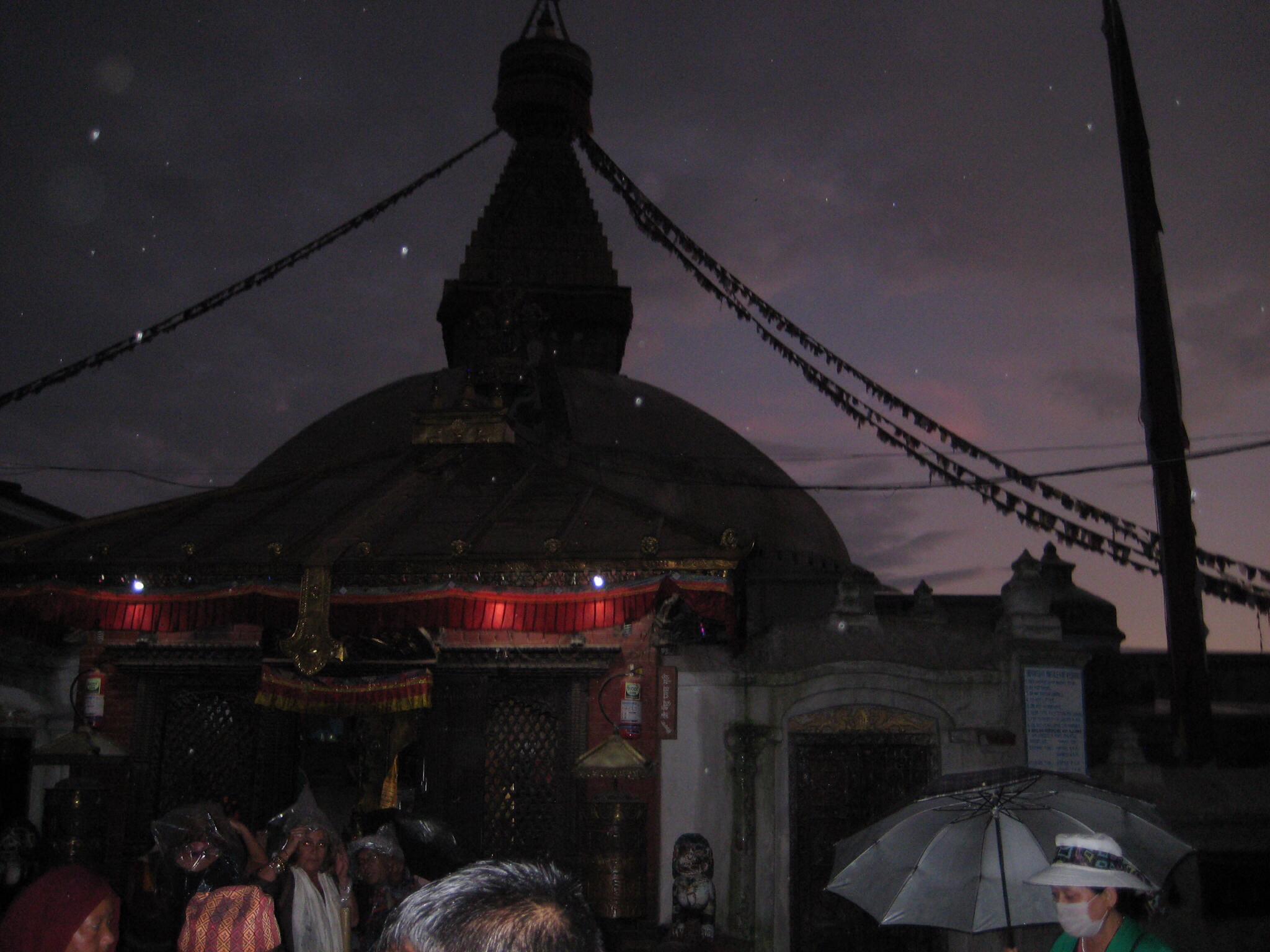
Boudha Stupa, Kathmandu, Nepal

As I walked through Boudhanath, Kathmandu, one evening in September of 2013, under a light rain, I was enveloped in the crowd. Everyone was headed in the same direction, toward the Great Stupa. I was reminded of Barcelona, where I had been the week before. But here, instead of heading to the plaza to sip wine and share food with family and friends, we were headed to a sacred place to walk in brisk clockwise circles murmuring prayers.. or chatting with family and friends. I love both customs and the way they bring people together in a shared space at the same time.


Nostalgia

I’ve reached that moment of awkward disequilibrium that often occurs in my travels when it’s almost time to return home. It’s an ambiguous sort of nostalgia, where missing home is offset by awareness of how much I’m going to miss the place where I am now when I’m not here anymore.

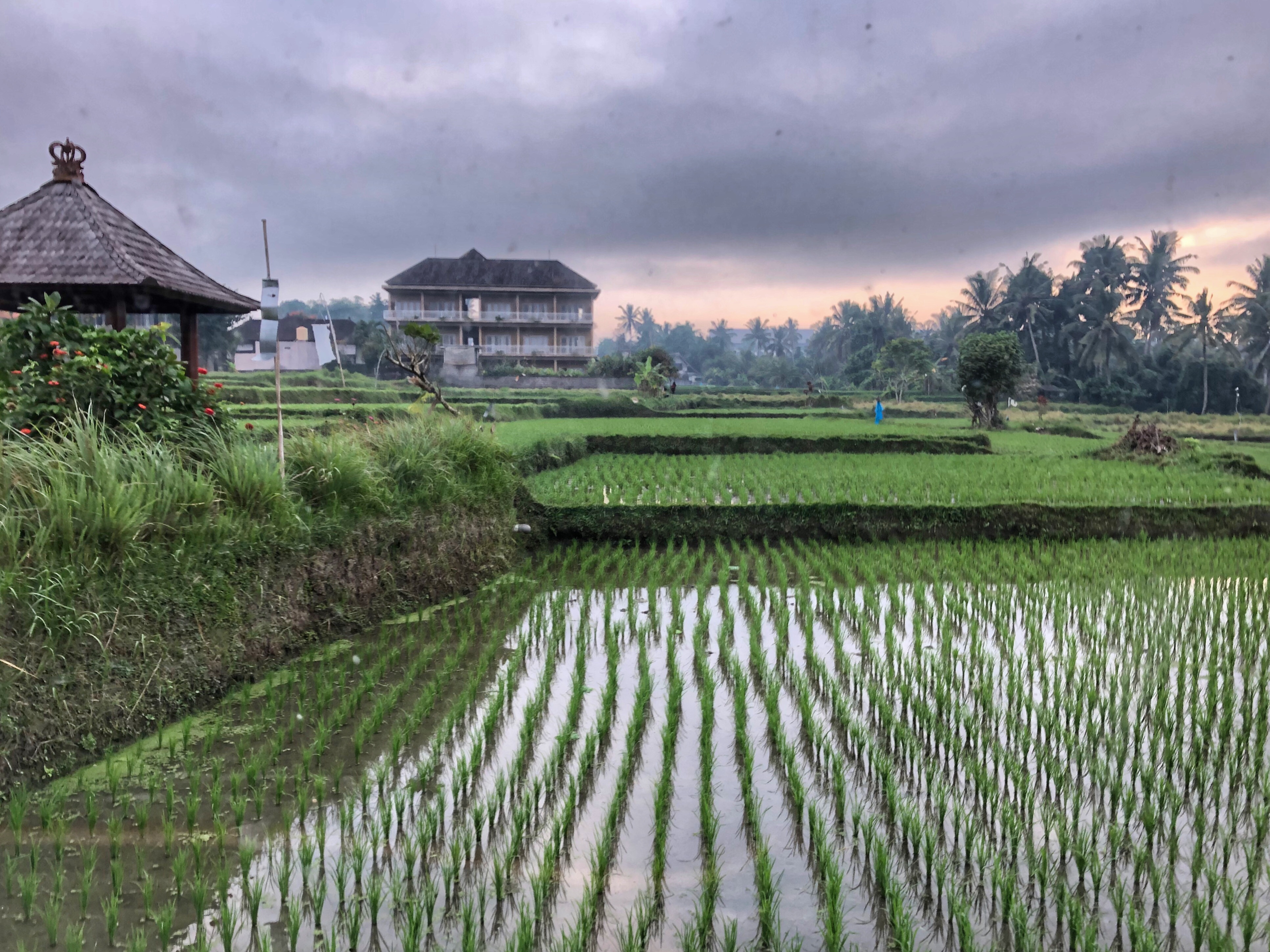
I love Bali. I love the weather and the landscape and daily life in the banjar of Kutuh Kaja. I love the deep cultural persistence, the aliveness of ancient temples that are replenished daily with artfully composed fresh offerings. I love the strong sense of place among people for whom kaja (toward Mt. Agung) and kelod (away from Mt. Agung) are as important as east/west or north/south. I love that Mt. Agung is an active volcano. I love the artistry, the taksu, that has not (yet) been obliterated by the influx of treasure-seeking tourists. I love the dignified bearing and “bright faces,” the ready laughter, of young and old alike.

I’ll miss you, Bali.

But I also miss my family. I’ll get to see my daughter and son-in-law for a couple of days on my way home. I miss them a lot. I’ll soon get to hug my precious grandchildren again – I’ve missed them and their parents (my son and daughter-in-law). I’ll soon retrieve my little bird from her “summer camp”; I’ve missed her, too. I’ve missed my familiar spaces and places and habits.

They say, “Wherever you go, there you are!” But it’s also true that wherever you go, you’re not in any of those other places you hold in your heart. Nostalgia can happen anywhere once you’ve fallen in love with more than one place.

Maybe I’ll just go with Ram Dass: “Be. Here. Now.”

Beaches

Full disclosure: I’ve never been much of a beach person. As a child, I got severely sunburned more than once on beach outings, so I learned early on that sun is not necessarily my friend. There’s a lot of sun at the beach.

I also react badly to wind; it exhausts me very quickly. There’s often a lot of wind at the beach.

Sand? It’s fun while you’re there, but it has a bad habit of lingering in shoes and clothing, where it is considerably less fun.

My main character, Meg, in NOT KNOWING has an aversion to large bodies of water. The water, in fact, is perhaps the only thing I love about beaches. But do I swim in it? No. Like Meg, I wade and dabble and admire it from the shore.

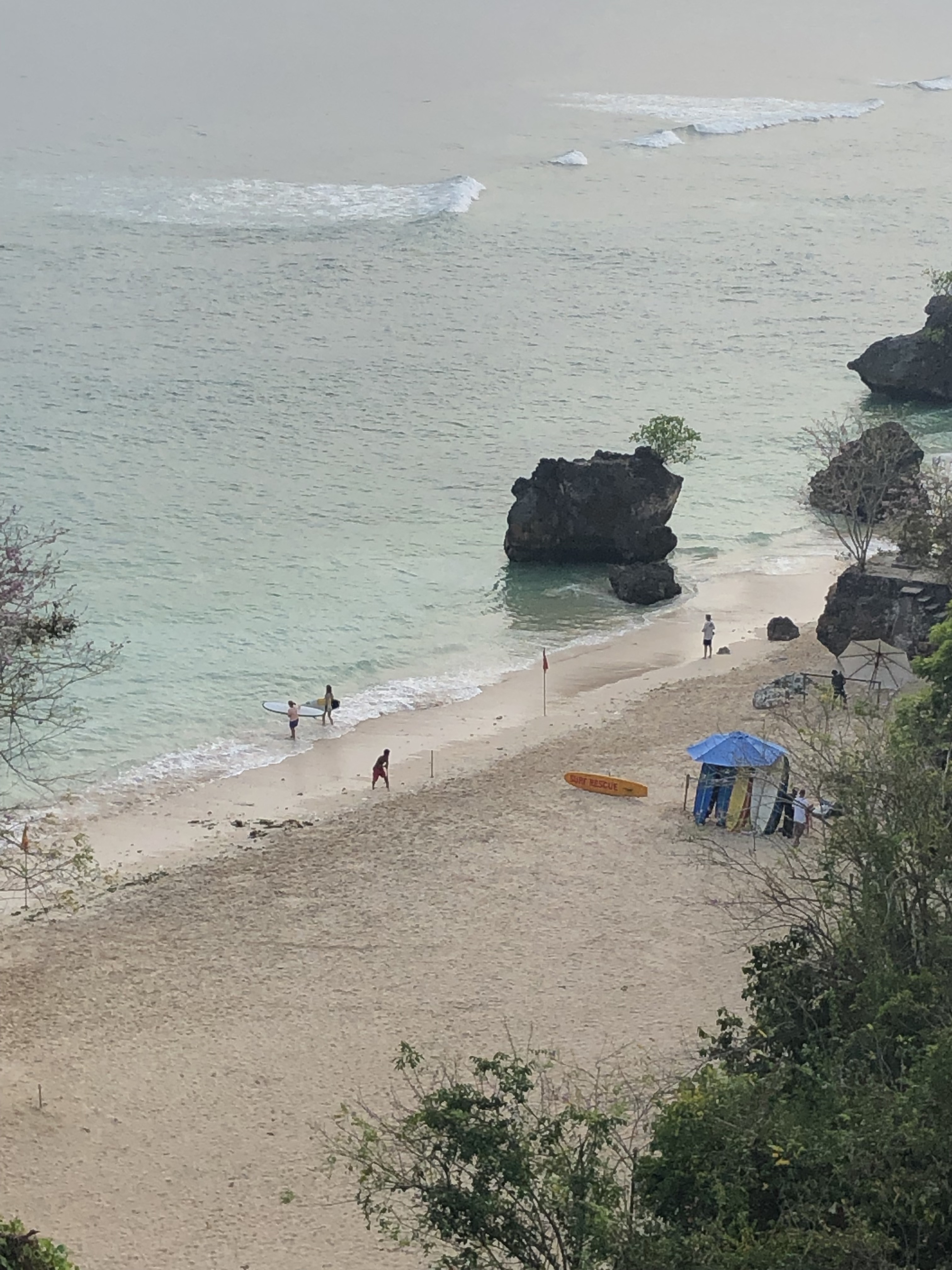
The beach here at Labuan Sait and Padang Padang, Uluwatu, Bali, is a beautiful beach, with majestic rock formations and soft white sand caressed by turquoise waves. Indonesians and foreigners mingle pleasantly, sipping chilled coconut water straight from the coconut or maybe a couple of Bintangs (Balinese beer). There’s also skewered chicken and corn on the cob, grilled right on the beach.

But that was yesterday, at low tide.

This morning the tide has come in, the beach has shrunk by half,  and the surfers are taking over. I have nothing against surfers, mind you. I know some really nice folks who surf and I get that it could be a really amazing experience, riding the crest of a wave and feeling the power of the ocean beneath your feet, trusting your strength and skill to keep you from being swallowed up. So it’s not the surfers I mind, it’s the culture that tends to spring up in their wake- the generic shops and cafes. Even worse is the luxury beach culture, with its insistence on all the modern conveniences of home, sprinkled lightly with a curated collection of enticing local flavors. But then you already know I’m not much of a tourist.

And yet…here I am, on the beach at Padang Padang. In Bali. I intend to enjoy my day to the fullest. Pass me the sunscreen!


The View(ing)

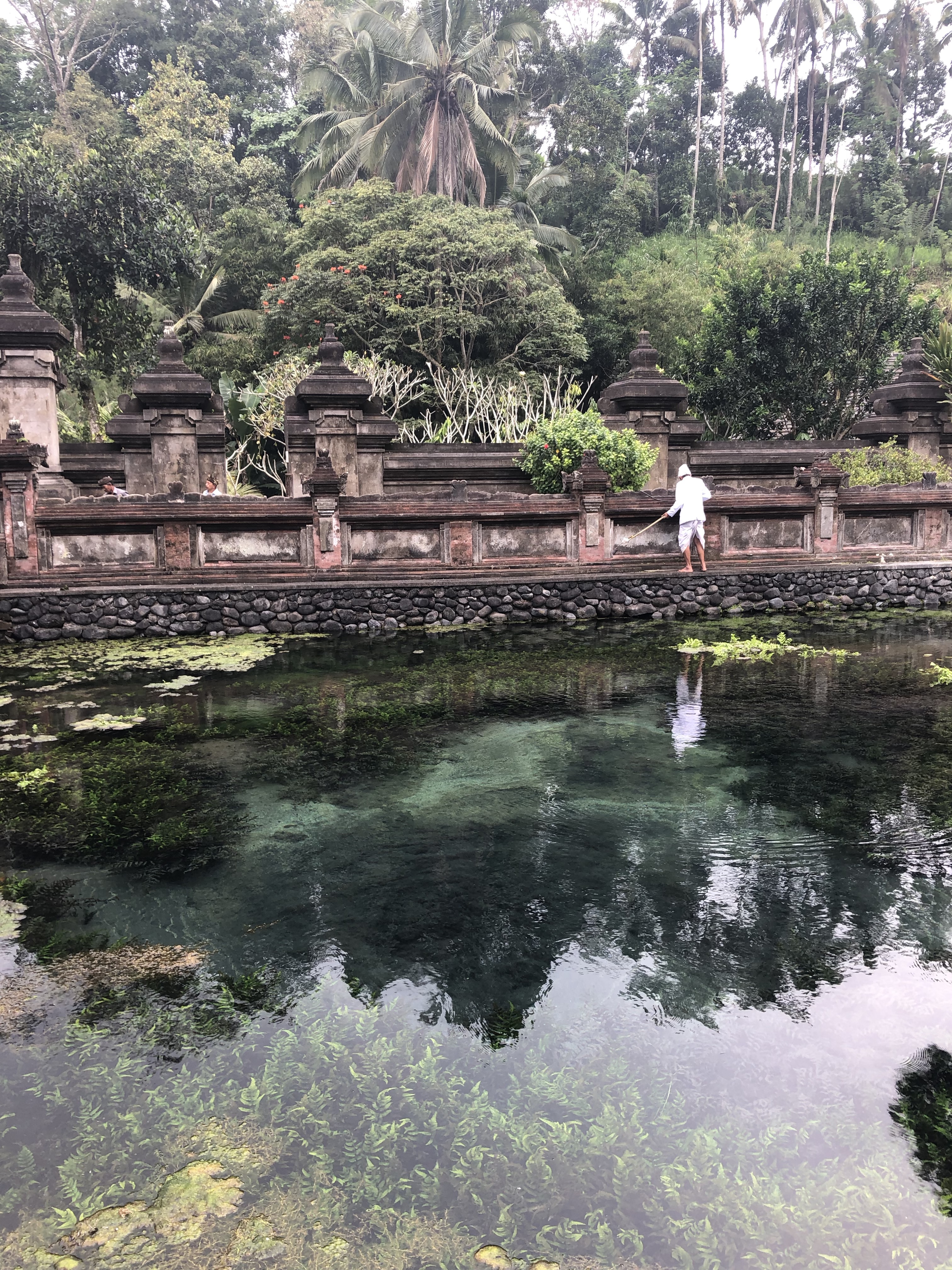
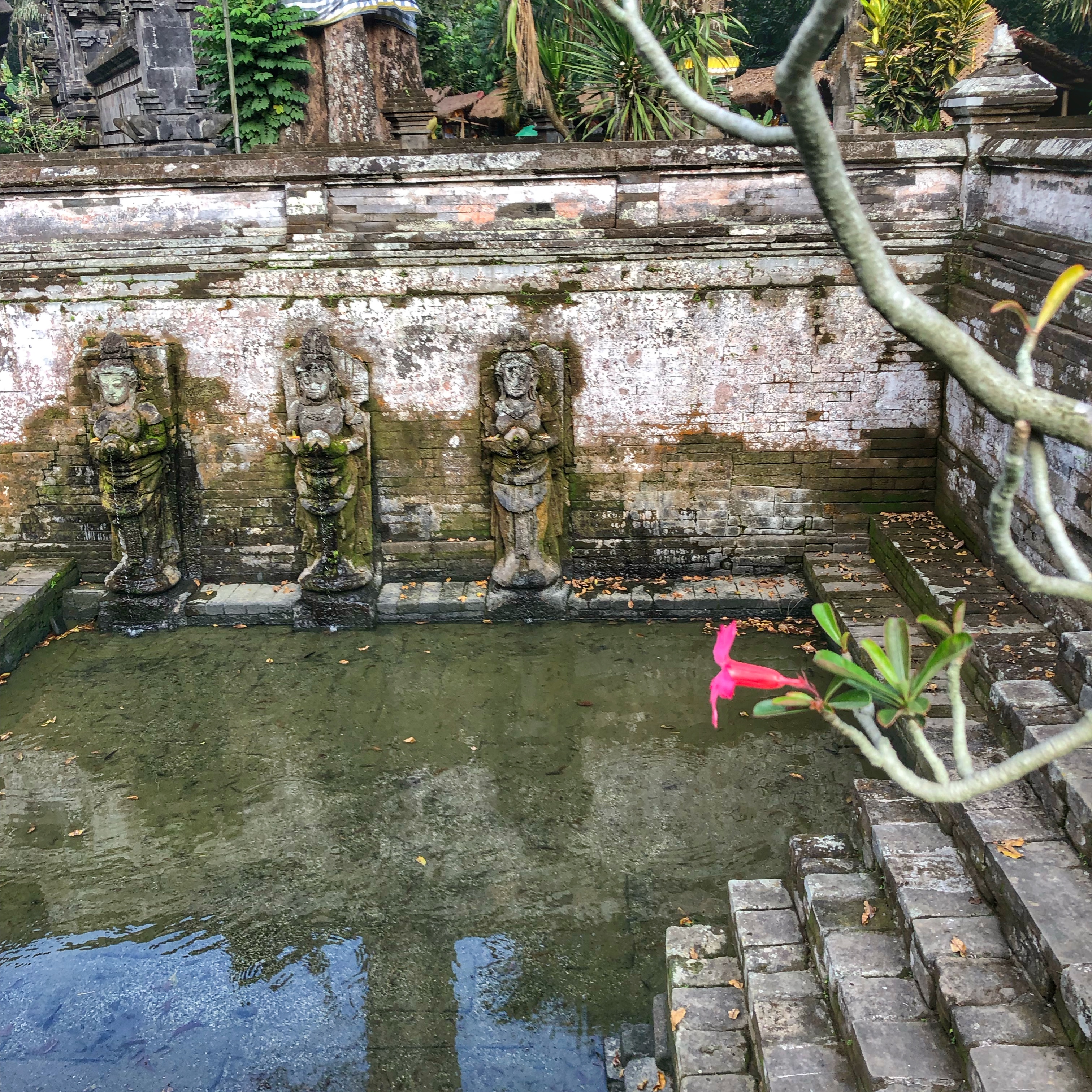
In preparing for our visit to Pura Tirtha Empul at Tampak Siring yesterday, I had to decide whether I was going to enter the holy spring waters or not. “Can I just take darshan from looking at the waters?” I asked.

Not familiar with darshan? Here’s how it is understood in Hinduism: “Darshan, (Sanskrit: “viewing”) also spelled darshana, in Indian philosophy and religion, particularly in Hinduism, the beholding of a deity (especially in image form), revered person, or sacred object. The experience is considered to be reciprocal and results in the human viewer’s receiving a blessing.” (That’s what Google said.)

At a somewhat deeper level, there is the sense that viewing something/ someone sacred or powerful results in real contact. Even westerners sometimes talk about “laying eyes on” a person or thing. With darshan, it’s as if there’s a kind of energy that passes between the two participants in the viewing, with agency on both sides.

All of this led me to wonder something else: Can I take a blessing away with me in the form of photonic patterns inside my iPhone? Can darshan happen again when I look at such images as they come up on Facebook memories five years from now?

In the final analysis, I spent some time gazing at the waters of Tirtha Empul, quietly contemplating amid the splash and hubbub of my fellow  blessing seekers. Then I walked to the edge of the water, dipped my hands into the flow and sprinkled some water on my head. I also took pictures.


Guests & Tourists

I’m not a very good tourist. I tend to either avoid the highly packaged “attractions” or else sneak in around the edges, on my own time, doing my own thing. I deeply respect the rights of the local people to keep us gawkers cordoned off, herded into manageable tours and treks that interfere as little as possible with their “normal” lives while still permitting them to earn income from our desire to gawk.

Don’t get me wrong, I like to see the historic and cultural “places of interest.” But I like to know what I’m seeing. All too often, what you get from tour guides is a watered-down (and occasionally downright fabricated) version of history and culture. Like pablum for babies, with lots of sugar.

I’m reminded of clearing my Uncle Bill’s bookshelves in San Antonio, Texas, after he passed. His partner, Ann, had owned the travel agency at Joske’s back in the latter half of the 20th century and my, how the two of them did travel! Uncle Bill’s books were not travel guides, however, but travelers’ memoirs and language books – Chinese, Korean, Greek, Italian, Spanish, Russian, French, etc. They always wanted to know at least a little of the language of their hosts. Sometimes they even took classes before the trip. I think “tours” have changed a lot since Ann was selling them at Joske’s. I also think Ann and Bill were not themselves tourists. They were interested and respectful guests.

Earlier this week I stopped in at a little shop in Ubud that sells locally crafted fabrics. The girl behind the counter seemed quite knowledgeable as she told me about the beautiful cloth she spread in front of me and how it was used in her village as protection against bad magic. She would sell it to me for a mere five million rupiah (~$350US). She seemed almost apologetic about the backwardness of her beliefs and offered some admiring words about the culture I come from. “But why do you think we come here?” I said. “It’s because we have to get away from the chaos and noise of our culture. We come here for beauty such as this.” And she smiled as tears glittered in her eyes.