A writer I follow on Twitter made the point that Memorial Day is not a day for calling up your military vet friends to thank them for their service, but rather a day for remembering those who died in service to our country.
Technically, she’s right, of course. But I think maybe it’s both.
I think it’s also a day for remembering all of our returned vets who have committed suicide and those who continue to do so with alarming regularity.
I think it’s a day for remembering homeless vets.
I think it’s a day for remembering the dreams that died on the battlefield with lost limbs and lost sanity.
I’m especially vulnerable to such sentiments this year because my next novel delves into these issues and especially into the legacy of family hardship that follows along with them.
I honor those who have given of themselves in honorable service. But I also hope for a day when we no longer sacrifice our young men and women’s lives and limbs and dreams in the service of ill-advised wars and interminable conflicts.
My Books
On Saving Daylight
Welcome to Daylight Savings Time – again. Why we continue to torture ourselves with this semiannual self-imposed time disruption is beyond me. Today’s Washington Post includes a piece on this annual ritual that refers to it as “a glitch in the matrix that reminds us that clock time is always artificial and arbitrary”. I’m using it as a reason to share with you a passage from my second novel, Shadow of the Hare, in which protagonist Malia Poole reflects on the relativity of our experiencing of time.
When I first arrived in Walden 27, I still felt the need to know the exact time of day or night and I positioned my little digital clock on my table like some deity in a shrine. I learned that Walden 27 was positioned at the far western extreme of the Eastern Time zone. There were only two North American time zones by this time; I remembered having read that, before the original four time zones were established for the convenience of railways in the 19th century, every town kept its own time, keyed to its own experience of the sun’s movements. I came to realize that time zones and clocks meant little to the community of Walden 27.
As my stay extended into weeks and then months, I, too, stopped keeping track of time. It’s all relative anyway, I told myself. We mark our distance from some event in the past or from some planned, imagined future, organizing our activities within the diurnal/nocturnal cycle, across the flow of seasons. In Walden 27, residents rose with the sun, broke for lunch when the sun approached its zenith, or when the temperature rose to a point making a break desirable.
Tracking the cyclic phases of the moon became more important to me than the name of the month or the count of days on a calendar. I noticed how the moon phase tracked with my menstrual cycle. I began to observe the stars and how they shifted position in the sky as we moved toward spring. They don’t actually shift, of course; it’s we who shift our position relative to them. I’d never seen so many stars before coming to Walden 27.
When spring came, the yard around my cottage was planted with a variety of fruits and vegetables. Every square meter of fertile land in the whole of Walden 27 was planted with something edible or useful and it was all worked cooperatively, which meant that I was always encountering people in my garden, working the ground, tending the plants. I had to remind myself it wasn’t “my” garden, though I soon began to do a little weeding there and, later on, I did claim some of the produce for myself.
The lack of regimentation was seductive. In Walden 27, we kept our own time. I relegated my little clock to a dresser drawer.
Shadow of the Hare: Recall Chronicles, Vol. II – available on Amazon.
Ask Questions!
“You need to ask more questions!”
This line is in the opening scene that launches the action of both Way of the Serpent and Shadow of the Hare. It’s advice that I hope readers of my books take to heart and, to that end, I’ve included lists of questions at the conclusion of both books.
One of the things I’ve been hoping for is that one of my books might become a “book group” selection—and that has now happened! A group of professors at Lamar University read my book and then Skyped me in for a discussion last week.
It was a thoroughly delightful interchange. I learned that Way of the Serpent caused them to think more deeply about the whole question of memories, their imperfection, the importance of how we share them with others, how we invest them in the objects with which we surround ourselves. I learned that they found it reassuring to see quality human relationships surviving all the gadgets and conveniences of my hypothesized future. I learned that they found the story’s ending (over which I agonized so much in the writing) to be poignant and appropriate. They liked the excitement of the story itself as it unfolded. They also liked the artificial trees with miniaturized 3D printers producing leaves in appropriate seasonal colors!
In my new book, Shadow of the Hare, the protagonist is a novelist who muses about her own writing:
“Were my stories the kind that lured people into unrealistic delusions? I hoped not. I hoped they were, instead, the kind of stories that opened windows onto the true nature of things, shedding light, inviting fresh thinking, dispelling confusion.”
If you like asking questions, contemplating answers, I hope you’ll come to my next public reading – June 9 at Malvern Books – where we’ll have the opportunity for a Q&A session!
Here are the questions I came up with for my books. I’m sure you’ll have more!
Looking at the Moon
I don’t choose the titles of my books lightly. Way of the Serpent dealt with an old New Guinea folk tale about a contest at the beginning of time for human destiny, a contest between a bird and a snake to see whether human beings would be like snakes, shedding their skins and living forever, or like birds that have to die.
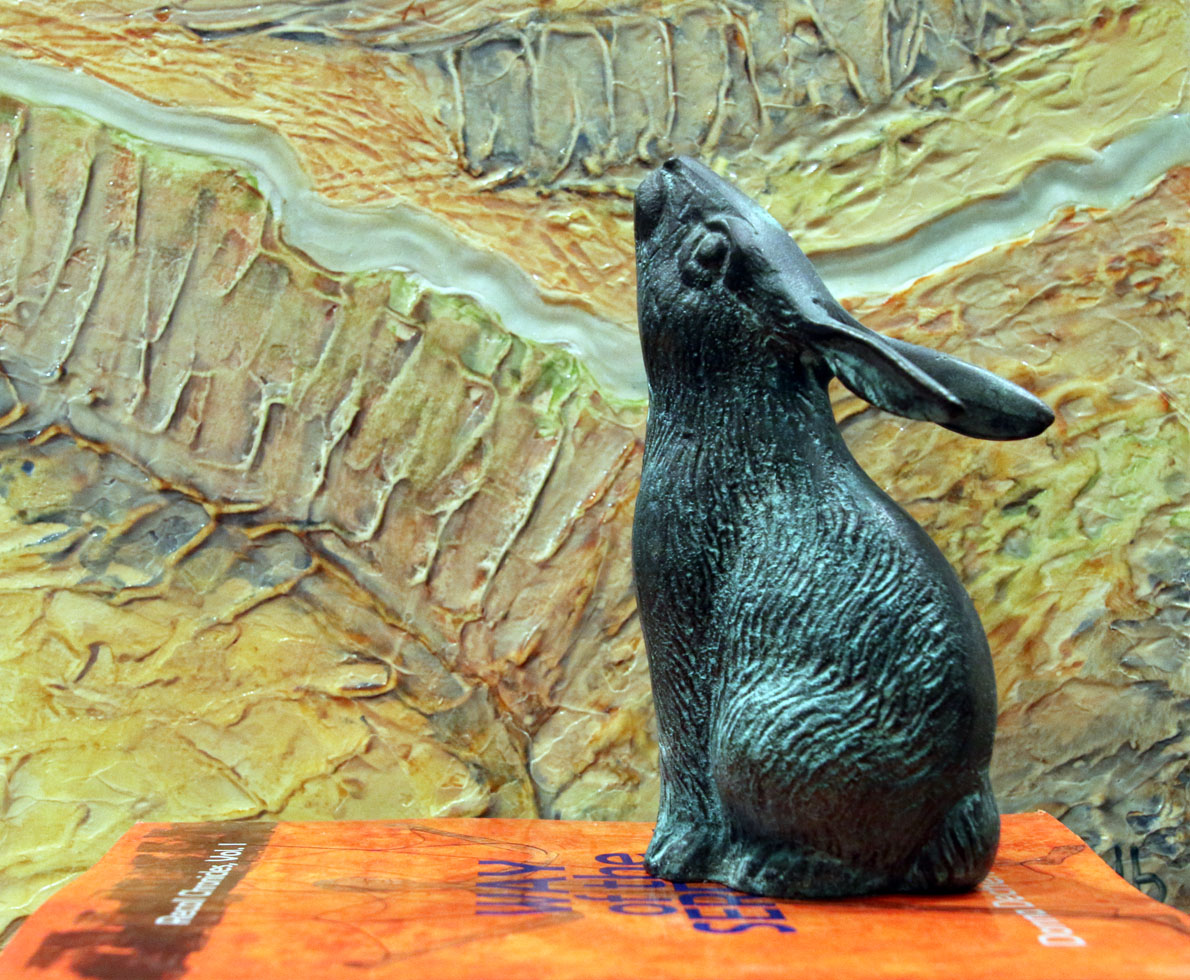
Shadow of the Hare takes on the question of our human tendency to project our own wishes and desires onto the objects and experiences of our world. What do we see on the face of the moon—a human face? A hare? It depends.
My highest aspiration is to write books that readers will want to go back to—to think about, to read again. I want to raise questions in the reader’s mind that will lead somewhere, not offering easy answers to life’s tough questions, but offering, perhaps, a sip of wine to aid digestion.
Here’s to your enjoyment of my next book—cheers!
Available on Amazon.
Book launch event Saturday, May 21, 1 to 4 pm at Half Price Books on North Lamar, Austin, TX.
Read the first chapters of Way of the Serpent HERE.
The Hare Moon
Whether you celebrate Beltane or May Day or nothing at all, it’s good to take note of the first day of May, as it brings us ever closer to summer. It’s no wonder the day was traditionally noted by our agricultural antecedents in Europe as a time for the celebration of warmth and fruitfulness, fire and fertility!
I find this particular May Day exhilarating, as it marks the beginning of the month I’ve selected for release of my next novel, Shadow of the Hare. This particular celebration is set for May 21, the day of the full moon that is known is some quarters as “The Hare Moon”.
Associations of hares (sometimes rabbits) with the moon abound in folklore and I’ve always felt a personal resonance with the creatures. The symbolism has worked its way into my novel. Here’s a small taste–it was hard to find one without spoilers!
I remember the year 2053, the year of the Global Peace Accord that officially put an end to war. Lio and I had gone to watch the celebratory fireworks displays on the D. C. mall, sitting in the shadow of one of the big war memorials next to a shallow pool. We lingered, watching the full moon rise, long after the crowd dispersed.
“How do you think they finally got the big weapons manufacturers and military corporations to sign on to the accord?” I asked.
“I’ve wondered about that. I wish I knew. They’ll never make much profit just making explosives for fireworks.” Lio grinned at me. “Although tonight’s show was pretty spectacular. And by that I mean over-the-top excessive.”
I snuggled up closer to Lio as a breeze rose up, rippling the water on the pond where the full moon was reflected. “Of course, weapons aren’t just guns and bombs these days,” I mused.
“Did you ever see a man in the moon when you were a kid?” Lio asked.
“Yeah. At least I think I did.”
“Did you know that in some other parts of the world people see a hare on the face of the moon?”
“I read about that once. I could never see it though. I guess we see what we’re conditioned to see, right? Whatever our culture tells us is there?”
“Probably. And maybe we want it to be a living thing,” he suggested, “something with a face and eyes. Something we can relate to.”
“Can you still see a face on the moon?” I asked.
“Not really.”
“Me either. Though sometimes I wish I could.”
PRE-ORDER Shadow of the Hare on Kindle and receive it May 21st!
Celebrate release of Shadow of the Hare May 21st, 1 pm to 4 pm, at Half Price Books on North Lamar in Austin. Get your signed paperback copy and register for free gifts!
One Is the Agent
I needed a new cover for the re-issue of Way of the Serpent, something that could provide the basis of covers for sequels in what has now become the Recall Chronicles. I analyzed the covers of dozens of other dystopian science fiction novels. I perused photographs available online. I searched through my own considerable inventory of photographs.
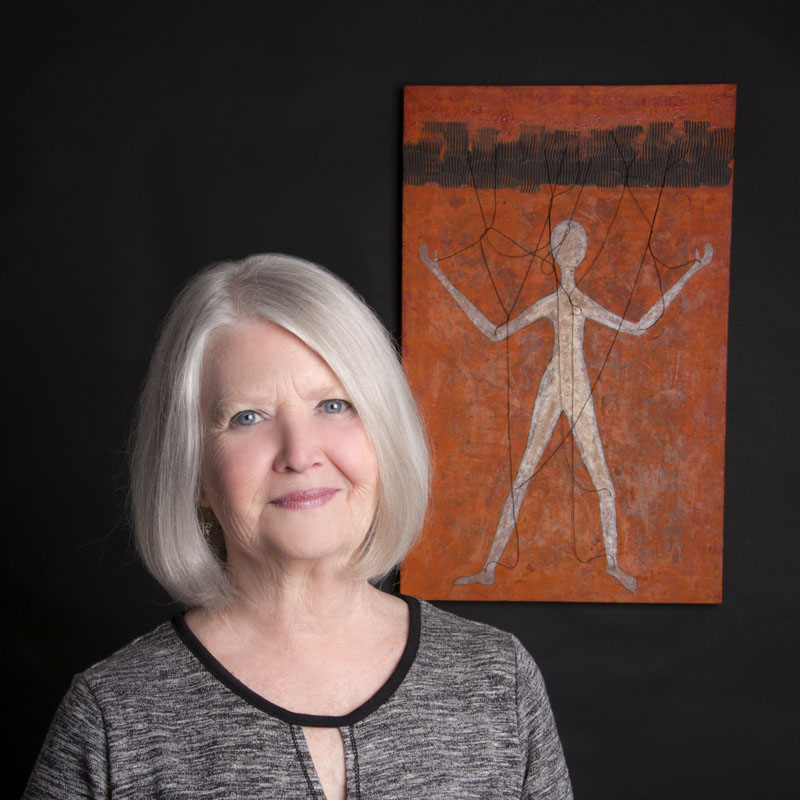
I kept going back to this one painting (see above), to which I’d attached a rather complicated title, a title that was in fact a line from a Buddhist practice I did sometimes: “One is the agent, caught in the reaction of cause and effect.”
The more I thought about it, the more I came to the conclusion that this painting and my novels were coming from the same space, a space in which agency constantly grapples with conditions that are, after all, oftentimes a result of one’s own actions. We’re not puppets, but we’re never free of entanglements, never entirely free agents.
The characters in my novels are like this, valiantly battling the circumstances of their lives, circumstances that are, to a varying extent, their own fault.
If these sound like the kind of characters you’d like to read about, you’ll like Way of the Serpent and (coming soon!) Shadow of the Hare.
The Encounter
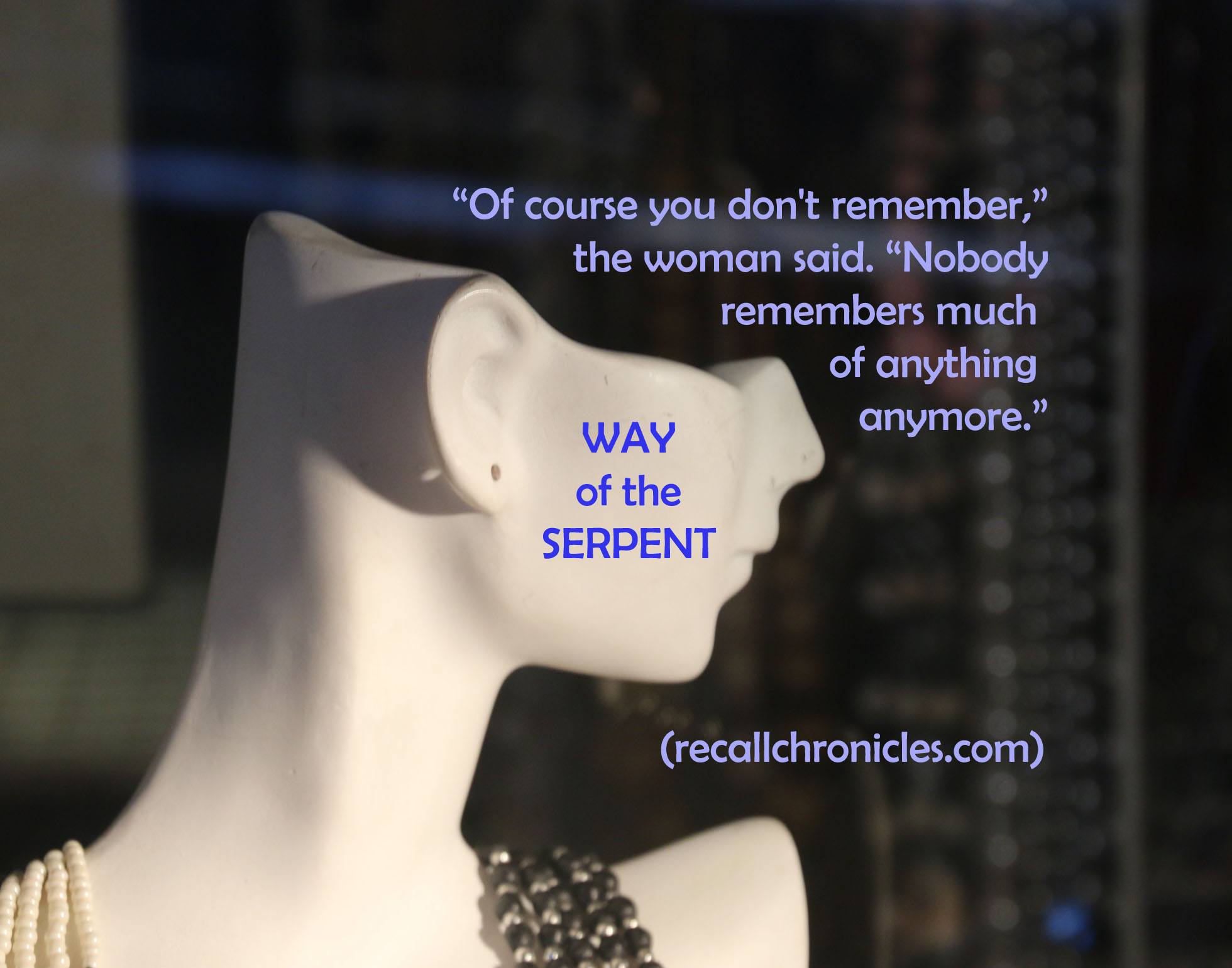
Way of the Serpent opens with Jenda Swain’s encounter with an old woman, a woman Jenda doesn’t remember. “Of course you don’t remember,” the woman says. “Nobody remembers much of anything anymore.”
Shadow of the Hare begins with the same scene, but this time the reader is seeing it from the viewpoint of the old woman, Malia Poole, a dissident author and bibliophile. Here is what happens as Malia leaves the cafe where the encounter occurred:
Tears began to fall as soon as I was out on the street. I felt betrayed. Damn these disconnected memories! I have more memories than most people these days, but there’s that one year from high school—the period when I knew Jenda best—that’s always been a blank. At least until recently. It’s cruelly ironic that now I’ve reached an age when normal memories start to fade, these submerged ones begin to wash up like shards of sea glass on a beach. I write them down, cataloging them like curios of uncertain provenance, although sometimes I wish I could hurl them back into the ocean of forgetfulness from which they came.
After I left the café, I couldn’t stop thinking about Jenda. She felt like a key to something. I may not remember a lot about her, but I do know that up-tight little prude with the pressed lapels isn’t the girl I knew in high school. I’m pretty sure that back then she was a passionate Vintagonist. Something had happened to her, something very different from what has happened to me.
Preorder Shadow of the Hare.
You haven’t read Way of the Serpent? Free download continues through April 9.
The Lady in Blue
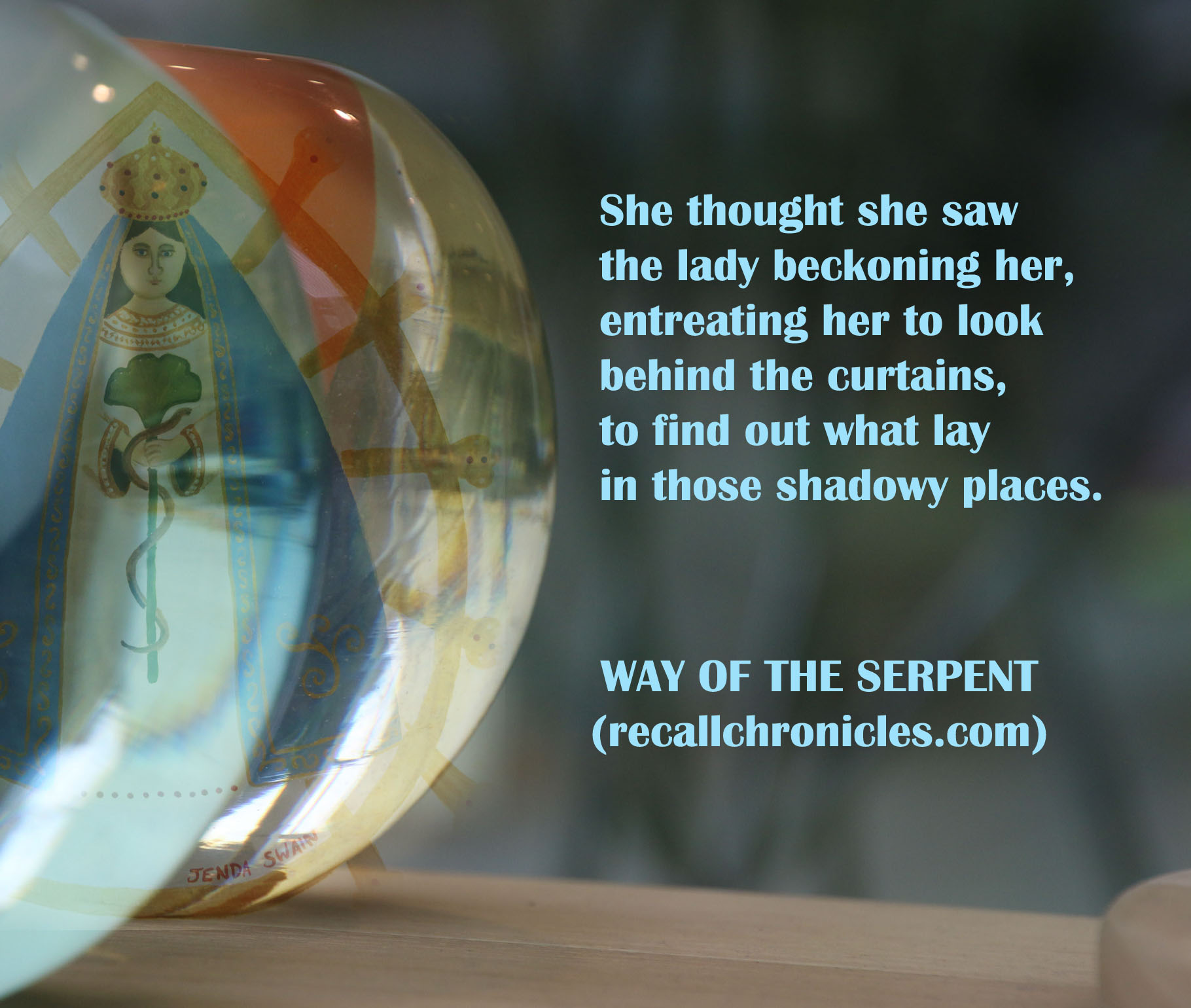
Jenda Swain is a woman haunted by half-remembered things, among them a mysterious lady in blue. Who is this lady and why does Jenda find her kind countenance so terrifying?
Read Way of the Serpent – available on Kindle for free through April 9.
Welcome to the Recall Chronicles!
In a 22nd-century world suffering from collective dementia despite its achievement of perpetual youth, the Recall Network schemes to restore a more natural order. But is it too late? Are the corporations too entrenched and powerful? Will Recall carry on in the face of the mounting pandemic?
The Recall Chronicles recount the stories of three very different individuals as they try to survive and make sense out of an increasingly senseless and insensitive world.
I invite you to enter the thought-provoking, dystopian world of the Recall Chronicles. Through April 9, you can download the Kindle version of Way of the Serpent for FREE. Even if you’ve already read this one, you’ll want the new one. Why? Because it includes a Discussion Guide for your book group and a brief excerpt from Shadow of the Hare – Vol. II of the Recall Chronicles, now available for preorder.
Where No One Has Gone
When I was a child, I used to imagine going to a place no one had ever been to before. There would be no trails, no trash, no trace of human presence. Over the years, as I studied the history of human migrations and tracked our exploding population and greedy exploitation of the remotest corners of our planet, I came to the realization that such places probably no longer exist. As I recently journeyed through West Texas, New Mexico, and Arizona, I decided I should simply revise my dream: not to go where no one has gone before, but simply to go where I have never been and to bring myself fully to the encounter.
In a recent Huffington Post article, Daniel Crockett writes about the trend in our culture toward seeking “wildness”, including purchasing the trips and costumes and paraphernalia that tell us we are explorers of the wilds. But we delude ourselves. “The wild you seek is not on some frozen summit, empty ocean or silent plain,” he writes. “The wild is within you.”
I find myself in agreement with Crockett’s proposal, and yet I would caution against naïve mythologizing of this encounter with our own wildness and with the natural world. It is something that my protagonist in Vol. II of the Recall Chronicles (Shadow of the Hare) deals with after she flees her urban world and lands in West Texas. “My excursion into nature quickly became a retreat into my own fanciful world,” she observes.
If we truly wish to meet the natural world, we must meet it as it is and not as we desire it to be or imagine it to be. It may not be as “wild” as we would like, but if we meet it with the wildness of our own hearts, our own nature, I believe we will find the encounter more than satisfying.
Coming in May 2016 – Shadow of the Hare (Recall Chronicles, Vol. II) – Malia Poole is a stubbornly dissident author and bibliophile in a world where books have ceased to matter and barely exist. Emerging from fifty years of self-imposed exile, she discovers a world far more terrifying that the one she fled.