https://donnabirdwell.substack.com/p/on-the-origins-of-a-book
Narcissa June Tarver is a figment of my imagination, conjured as the vehicle for a story I needed to tell about some of my ancestors and collateral relatives who lived in southern Mississippi in the years after the Civil War. I crafted her carefully. I made her by far the youngest in her family in order to make her an uneasy bridge between generations. I gave her a minor disability in order to make her of questionable marriageability. But even as she performed her assigned function, she began to take over, to assert herself as someone who had her own story to tell.
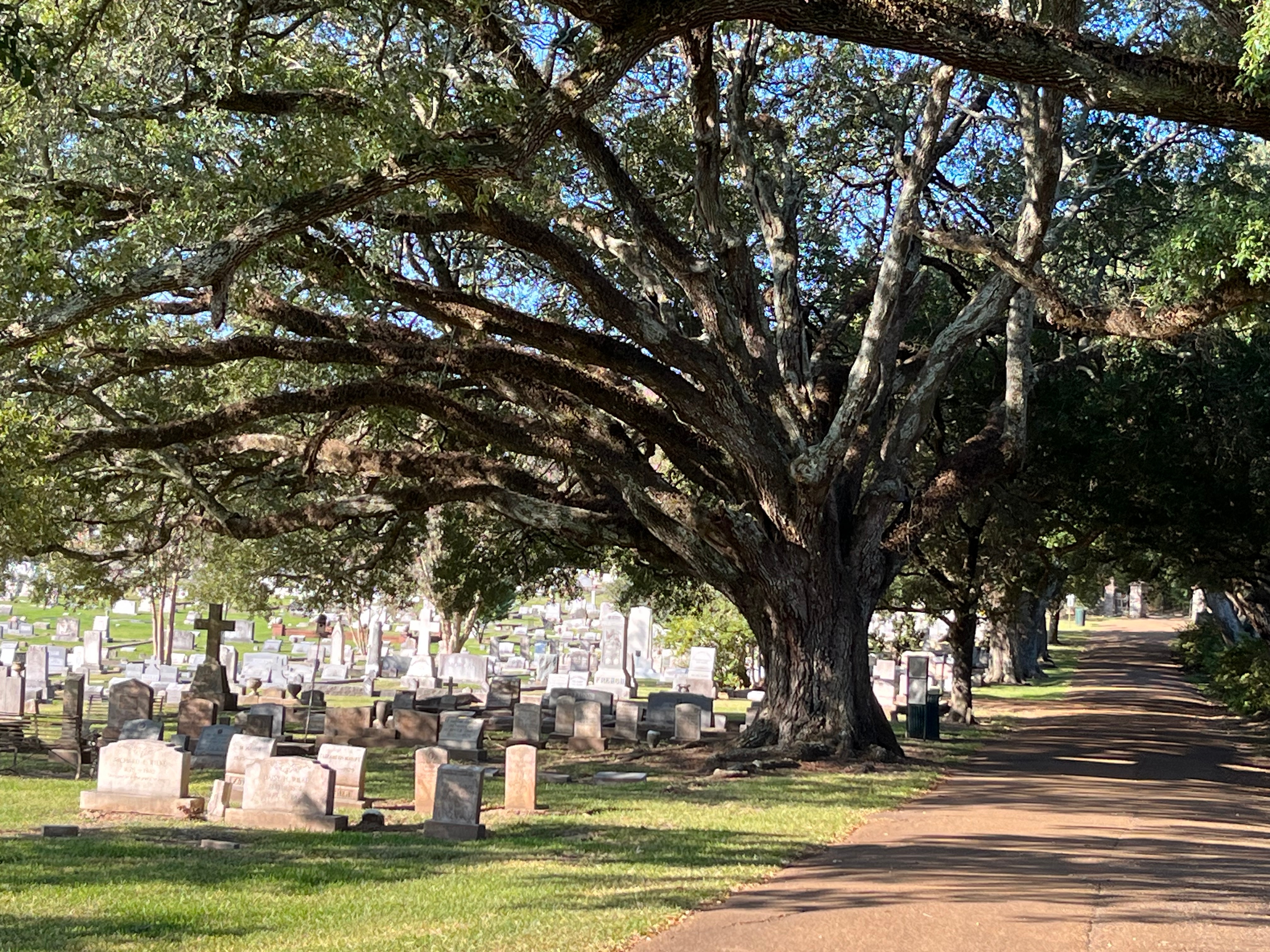
At this point, I was still calling her “Lucy,” but that increasingly didn’t seem to fit. Besides, there were too many other characters in Southern fiction called Lucy. One evening on my second trip to Natchez, as I was perusing names in my family trees and census records, I paused over the name “Narcissus,” which had been the middle name of one of my great-grandmothers. I liked it, but I wasn’t sure. The next morning, before leaving Natchez for Jackson, I looked through a book in my AirB&B about the Natchez cemetery. I noticed an odd looking grave of a fellow named Rufus Case (possibly a relation) who had reputedly been buried in his rocking chair. I resolved to search out the grave before leaving town. I found it. And on another side of the weirdly cubic marker was the name of another person buried there: Laura Narcissa Case. That clinched it. I couldn’t help but wonder if my main character hadn’t just told me who she wanted to be.
And so the story of The Disenchantment of Narcissa Tarver evolved—as works of fiction often do—as a collaboration between author and characters. Narcissa refused to be submerged in the tumult of her brother’s political career, consistently finding ways to play her own role in his very real world. I had to let her have her way. And now that her story is written and soon to be published, I think she may want more. A sequel? A story about the rest of Narcissa Tarver’s life after her “disenchantment”? That could happen.

One of my current writing projects—the one that is pulling at my sleeve most insistently at the moment—is not science fiction. It’s historical fiction. Is that a weird change of direction for me? Somehow, it doesn’t feel like it.
This morning I searched out the following words from my writing hero, Ursula Le Guin. Her perspective gives me welcome insight into my writing transition. Le Guin begins her brief essay by acknowledging our conventional assumption that the future (the usual subject of science fiction) is what lies in front of us, while the past (the subject of historical fiction) lies behind us.
“It seems that the Quechua-speaking peoples of the Andes see all this rather differently. They figure that because the past is what you know, you can see it—it’s in front of you, under your nose. This is a mode of perception rather than action, of awareness rather than progress. Since they’re quite as logical as we are, they say that the future lies behind—behind your back, over your shoulder. The future is what you can’t see, unless you turn around and kind of snatch a glimpse. And then sometimes you wish you hadn’t, because you’ve glimpsed what’s sneaking up on you from behind….” (“Science Fiction and the Future” in Dancing at the Edge of the World, 1989)
As I continue reading and researching the history of the American South (especially Mississippi) and the history of Scotland, both entangled in my own family history, I begin to see our future more clearly. I hope my story can bring the same kind of clarity to my readers.
Le Guin, Ursula K.. Dancing at the Edge of the World: Thoughts on Words, Women, Places (p. 215). Grove Atlantic. Kindle Edition.
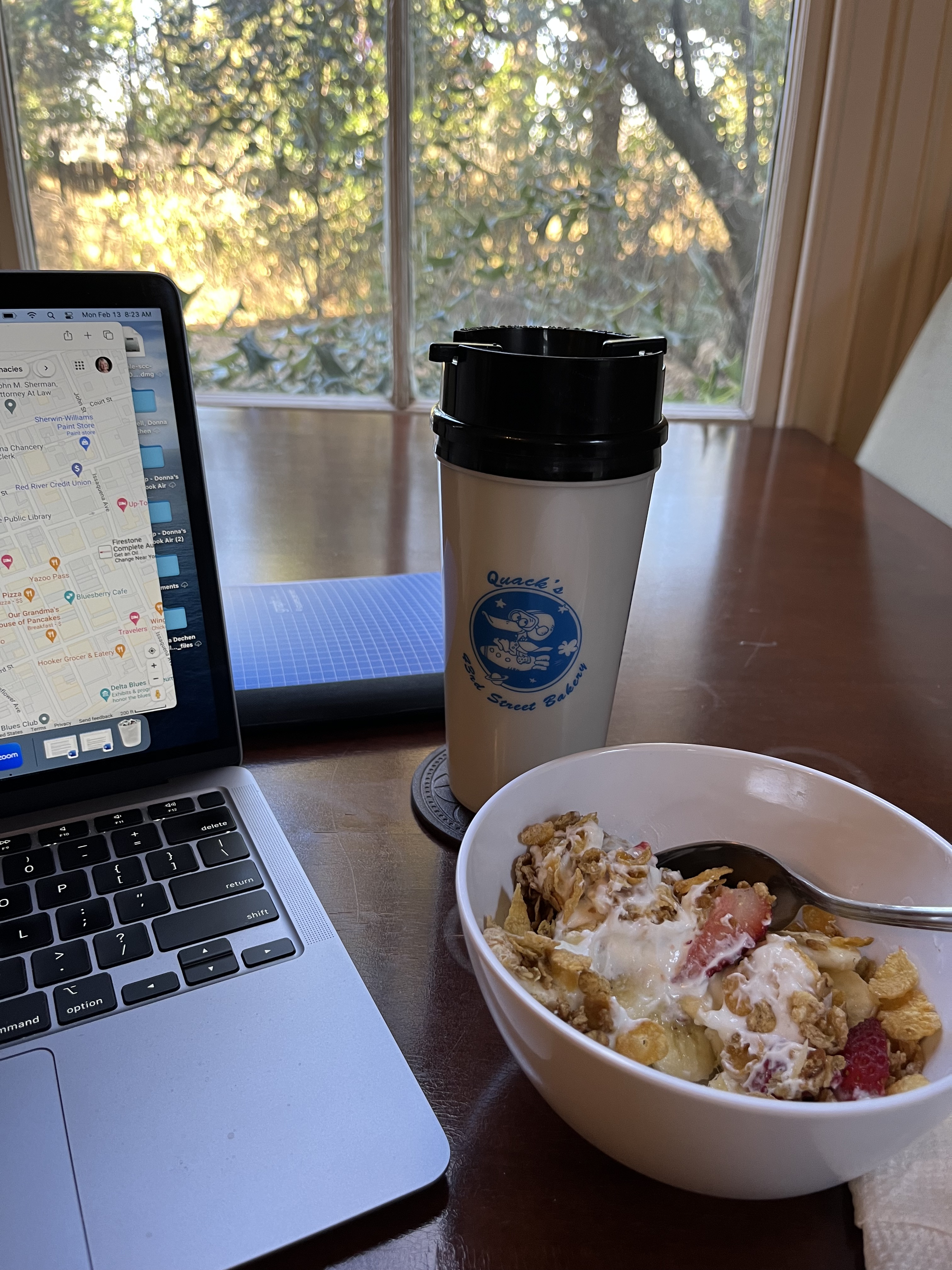
I sit eating my simple breakfast and watch a bird out the window as it hops and flutters from branch to twig and back again. An ordinary little thing, busily following the urges of its feathered kind to eat, stay safe, reproduce.
We humans have the same urges, except in more complicated form. We’ve turned dining into an art form, an industry, an elaborate set of social rituals. We seek safety not merely from the elements or true predators, but also from concocted and cultivated enemies. Reproduction? Necessary as always for the continuance of the population, but when is the last time we’ve really cared about that? No, we follow the urges—sexual and intimate—for their own sake. When we find an intimate partner whose company we would like to have as a fixture in our lives for the foreseeable future, we may embark on the project of bringing another generation into our circle. Whether we do that via our own sexual act or by adoption or surrogacy seems to matter little these days. However we do it, it results in continuity. The population continues. The species continues.
Some of us participate in continuity in other ways, choosing or accepting not bringing another generation into our intimate circle, while being useful in other ways to our society and culture, ensuring continuation that nurtures the next generation.
On this road trip, I’ve been driven by the desire to learn more about a particular relative of mine, a great-uncle who never had children, the kind of individual who is almost inevitably neglected by those of us who engage in ancestry projects of various kinds. I’m writing a story, but it won’t be a story about him. It will be a story inspired by what he’s teaching me. I’m almost ready to start writing it.

She was a woman caught in the cultural contradictions of her time. Born in December 1913, less than a year before the start of what became known as the First World War, she was only eight years old when it ended, too young for it to have mattered much to her. She grew up in unusually happy times as her father achieved success as a building contractor in a big city. As a young teenager, she received an allowance of $1 a week, the equivalent of $15 in 2021 value.
She was only seventeen when the Great Depression began to hit her family. She graduated high school and went on to college on a plan that permitted her to begin working early as a schoolteacher. Her family needed the income.
Soon she met and fell in love with a young man who was soon to be ordained as a minister—an honorable profession, though not a lucrative one. She was slightly horrified to find that his parents still lived on a farm. On her first visit, she couldn’t bring herself to use the outhouse and nearly burst her bladder on the trip back home. She married him anyway. In 1940, it was what young women did. Working as a teacher was only something you did until you married. Until you had a man to look after you.
But… in college, this woman had adored her art history courses, and through all the changes in her life, she held onto the art prints and teaching instructions she accumulated in those classes. She also loved poetry and memorized many lovely verses, although her extreme near-sightedness discouraged her from reading for pleasure.
As the Second World War loomed, her husband tried to volunteer as a chaplain, but was refused because of his poor vision. (In his case, it was a genetic condition that could not be corrected with lenses.) They struggled through together, birthing a daughter a few weeks after D-Day in 1944. A second daughter came along in 1948, three years after the war’s end.
In the small towns where her husband served as pastor, this woman found her teaching credentials in high demand and, as soon as her own two daughters were old enough for school, she went back to work. She always projected an apologetic attitude about working outside the home. She felt that she ought to have preferred focusing exclusively on home and husband and family. But she had a secret: She loved teaching. She couldn’t claim it as a career, because women of her era weren’t supposed to have careers. Just husbands and homes and families.
It’s difficult for a woman to be a good mother when she’s made to feel guilty for wanting more. And she can’t help but be slightly resentful about that. She also can’t help feeling like life has cheated her when she’s raised to have a taste for class and little luxuries and ends up trying to figure out what to do with the sack of onions her dear husband accepted as payment for a wedding ceremony. She was fortunate that the man she married was devoted and adoring, making her feel like a beautiful princess, even though he couldn’t afford the lifestyle.
I know you did your best, Mother. I wish we could have talked about it.


 Donna Dechen Birdwell