A writer I follow on Twitter made the point that Memorial Day is not a day for calling up your military vet friends to thank them for their service, but rather a day for remembering those who died in service to our country.
Technically, she’s right, of course. But I think maybe it’s both.
I think it’s also a day for remembering all of our returned vets who have committed suicide and those who continue to do so with alarming regularity.
I think it’s a day for remembering homeless vets.
I think it’s a day for remembering the dreams that died on the battlefield with lost limbs and lost sanity.
I’m especially vulnerable to such sentiments this year because my next novel delves into these issues and especially into the legacy of family hardship that follows along with them.
I honor those who have given of themselves in honorable service. But I also hope for a day when we no longer sacrifice our young men and women’s lives and limbs and dreams in the service of ill-advised wars and interminable conflicts.

books
A Little Truth

“A truism that often forestalls a quest for truth: the moment you’ve been waiting for always finds you totally unprepared for it.” — Fiona Maazel, A Little More Human
Truth is all around me. Everywhere. The “moment” Fiona speaks of is the moment of recognition, of seeing the truth that was there all along. So, really, how could I possibly prepare for that? It would be like waking up ten minutes early in order to be able to observe and find out what it’s like to wake up. The moment is already past! And there I am–awake and unprepared.
So does that mean I shouldn’t look for truth? That I should forestall my quest?
Absolutely!
Let truth find me, in all my requisite unpreparedness. Let it trip me up in the hallway, pounce on me in the street, drop on my head as I scurry through my day.
Honor the surprising truth.
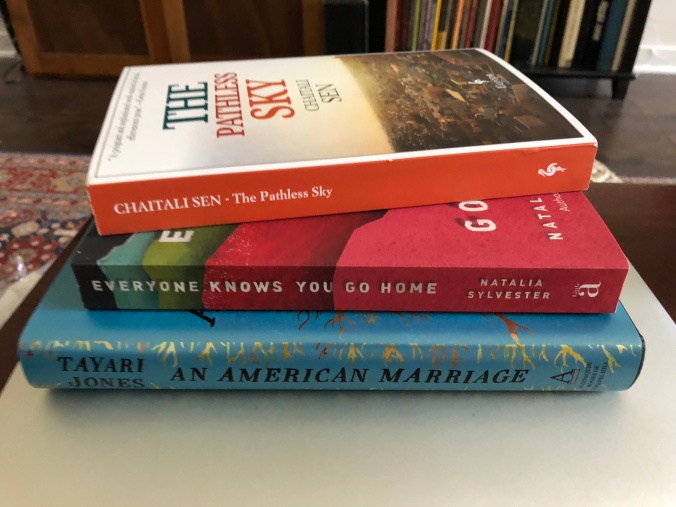
Three Books for Our Time

The three books I’ve read most recently seem to follow a theme. Maybe you’ll see it and maybe you won’t.
The first of the trio was Tayari Jones’ An American Marriage, a best-selling Oprah’s choice story about America’s most tortured long-term immigrants, those brought from Africa against their will, still struggling to claim their place in the 21st century. Second was Natalia Sylvester’s Everyone Knows You Go Home, a delicately textured tale of the many facets of the lives of several generations of Mexican immigrants. Third was Chaitali Sen’s The Pathless Sky, set in an unnamed country that might be Lebanon, a love story fraught with intergenerational responsibility and guilt and political conflict.
These are stories about how people struggle to build lives for themselves amid circumstances they cannot control – slavery, racism, poverty, violence, migration, and political turmoil. There are a thousand stories like these being lived out by real people every day and every day we sigh and turn our backs and say if only things were different. Every day people are leaving homes and families, going to prison or to foreign lands where they are treated like criminals or live in the shadows. They leave behind parents and lovers and childhoods and dreams. They go in search of happiness, just a little bit of happiness, just a little something salvaged from a bittersweet past, a little something to offer their children.
I strongly recommend all three of these books. Read them in any order you like. It’s a repeating cycle.
REVIEW: The Association of Small Bombs
I don’t do book reviews very often, but I’m making an exception. That’s because Karan Mahajan’s THE ASSOCIATION OF SMALL BOMBS is hands-down one of the most important books I’ve read in a long while. It begins with an act of terror – the explosion of a small bomb in an ordinary marketplace in Delhi – and follows the reverberations of the event backward and forward in time in the lives of both victims and perpetrators, exploring the unexpected yet inevitable interconnections and ultimately explaining better than I would have thought anyone could exactly what this thing called terrorism is all about. “You turn into what you hate,” one of the characters observes. I’m afraid he may be right.
Whatever Became of Books
Malia Poole, the protagonist in Shadow of the Hare (Vol. II of the Recall Chronicles), worked at a secondhand bookstore called Codex2 for nearly thirty years, during which “the story industry” was transformed by the rise of the plutocracy. It was a difficult time for a dissident author like Malia, but not an altogether unhappy time.
We worked together, conspiring with friends who shared our distaste for the society as it was, as it was becoming. There were periods of anger and frustration, but there was camaraderie in the midst of it. The further they drove us underground, the stronger our bonds became. We trusted no one but one another. We found ways of avoiding the corporate police, moving in the shadows, the interstices, doing what we needed to do without attracting too much attention. It wasn’t the most effective form of activism, but we became expert at being invisible.
Shadow of the Hare is available for preorder.
Free download of Way of the Serpent expires at midnight, April 9.