https://donnabirdwell.substack.com/p/on-the-origins-of-a-book
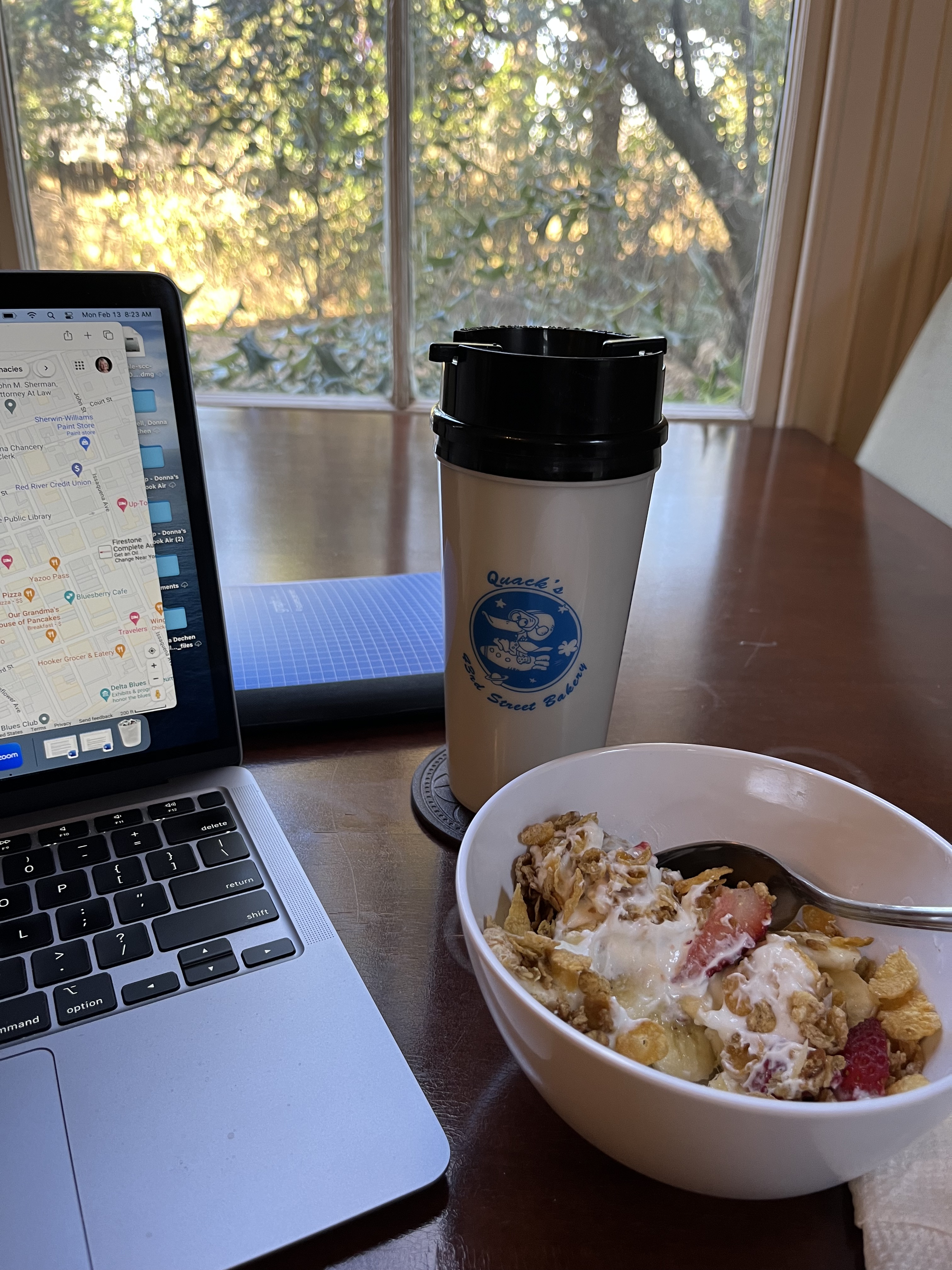
I sit eating my simple breakfast and watch a bird out the window as it hops and flutters from branch to twig and back again. An ordinary little thing, busily following the urges of its feathered kind to eat, stay safe, reproduce.
We humans have the same urges, except in more complicated form. We’ve turned dining into an art form, an industry, an elaborate set of social rituals. We seek safety not merely from the elements or true predators, but also from concocted and cultivated enemies. Reproduction? Necessary as always for the continuance of the population, but when is the last time we’ve really cared about that? No, we follow the urges—sexual and intimate—for their own sake. When we find an intimate partner whose company we would like to have as a fixture in our lives for the foreseeable future, we may embark on the project of bringing another generation into our circle. Whether we do that via our own sexual act or by adoption or surrogacy seems to matter little these days. However we do it, it results in continuity. The population continues. The species continues.
Some of us participate in continuity in other ways, choosing or accepting not bringing another generation into our intimate circle, while being useful in other ways to our society and culture, ensuring continuation that nurtures the next generation.
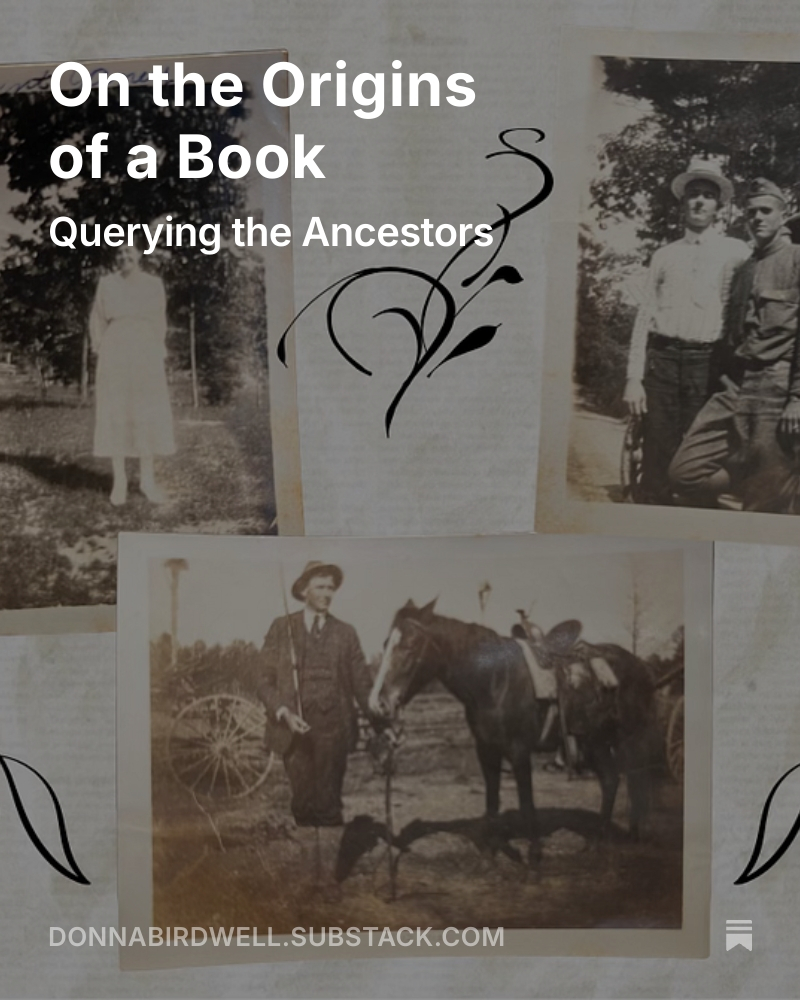
On this road trip, I’ve been driven by the desire to learn more about a particular relative of mine, a great-uncle who never had children, the kind of individual who is almost inevitably neglected by those of us who engage in ancestry projects of various kinds. I’m writing a story, but it won’t be a story about him. It will be a story inspired by what he’s teaching me. I’m almost ready to start writing it.

Today President Joe Biden turns 80 years old. If he wins a second term in 2024, he’d be 86 by the time he left office. A former President who has already declared himself a candidate is only four years younger than Biden.
Earlier this week, Speaker of the House Nancy Pelosi—who is 82—declared that she will step away from party leadership in the House of Representatives.
Biden and Trump should follow Pelosi’s lead.
This is not ageism. Clearly, two of these three politicians have still “got it” and have a lot to offer in terms of knowledge, wisdom, and experience. But why should we wait to retire until we can’t do the job anymore? We need to retire when it’s time to turn things over to the next generation.
The problem is not the old folks themselves, but rather the implications of their vital longevity for the generations coming up behind them. Never before in human history (I await correction if I’m wrong) have we found it needful to name successive generations—baby boomers, Gen X, Millennials, Gen Z—because there have never before been so many adult generations competing for access and relevance. (Earlier generations have been named only in retrospect.) Boomers have continued to hold fast to the reins of power while three generations of potential successors wait in the wings with increasing impatience. This election cycle saw the election to Congress of a member of Gen Z—our President’s great-grandchild generation. Something needs to change.
In societies the world over there have been mechanisms for moving society through generational transitions. It was a focus of my anthropological fieldwork (in Central America and later in Ireland) when I was in academia and it became the crux of the extended thought experiment I pursued more recently in a series of science fiction novels (the Recall Chronicles). As people live longer and maintain both mental and physical health well into their 80s and beyond, it becomes clear that we need more deliberate mechanisms of transition.
Tension is increasing to the breaking point between the stubborn boomer generation and the directions Gen X and Millennials (and, increasingly, Gen Z as well) want to take our society. Some boomers have kept up remarkably well with innovations in technology and advances in our understanding of history and genetics and climate science. Others not so much. But even those who are the most tech savvy and knowledgeable are incapable of truly comprehending the experience of the younger generations who have grown up in a world that diverges significantly from the one boomers knew in their own youth.
I’m not suggesting that the old folks be relegated to some equivalent of the Irish “west room” to which a farmer retired when they’d officially passed the farm on to an heir, becoming dependent and irrelevant as they waited to die.
But we definitely need to talk about this. For now, the best solution is for the old folks to graciously step aside, transitioning into an informal role as elder statesmen and stateswomen. Nancy Pelosi did this voluntarily. I hope Biden will follow her lead.
There are always things going on outside the purview of our daily news, our daily download of statistics, that are just as real as jobs reports and presidential briefings and high level negotiations among world leaders. Such offstage movements have always been there. Mostly they intend to be secret, subversive, operating outside established channels and laws. Occasionally they bubble up into our awareness.
Abbie Hoffman, way back in 1969, talked about the coalescing of distinct “nations” in America (my phrasing, not his). Back then, something like the Woodstock Nation had to be approached on foot, more or less. You arrived at that one via roads paved with various psychedelics, including electric roads of music. The (mostly) shared ideology was anti-capitalist and anti-racist and anti-war and (early) feminist. In the 1960s, the citizens of this “nation” gravitated not just to Woodstock itself but manifested the Nation in all kinds of gathering places all over the country.
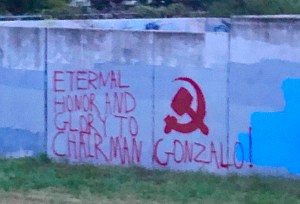
We’ve reached a new iteration of this kind of “nation”-building and it’s caused by the internet. I don’t mean “facilitated,” I mean “caused.” The internet and its massive social media platforms permit citizens to convene without ever leaving their homes or at least the reach of their cell service and wifi. Every once in a while I brush up against one of the alt-nations on Facebook or Twitter. Today I saw evidence of one right out here on the streets of my neighborhood.
Lest you think this is all a wonderful manifestation of ordinary people rising up against the oppression of capitalism, be advised that to the extent that these 21st Century “nations” are rising up in cyberspace, they are highly vulnerable to co-optation by the very forces they think they’re rebelling against. Maoism? And who built this cyber-marketplace anyway?
References:
Hoffman, Abbie. Woodstock Nation, 1969, Random House. (Yeah, Random House.)

I’ve never been big on secular celebrations of human achievement. It always feels a little premature. I’d rather give this whole “Independence Day” thing another couple thousand years to see whether it works out or not. At the moment, I’m not optimistic.
On the other hand, I do like picnics. I like outdoor gatherings with family and friends (when it’s not scorchingly hot due to climate change) and I kind of like fireworks.
I like the fact that so-called “gunpowder” was invented by the Chinese not for guns, but to create more impressive explosions, which supposedly were useful in warding off evil spirits. By the time the explosive mixture made its way westward, it was referred to as “Chinese flowers.” Soon it would be turned toward more destructive purposes.
As I lie in my bed later tonight, trying to go to sleep while the neighbors shoot off their probably illegal fireworks, I shall try to turn my mind toward the dispelling of malevolent influences and envisioning colorful lights blossoming among the stars.
BOOM! BANG! POW!

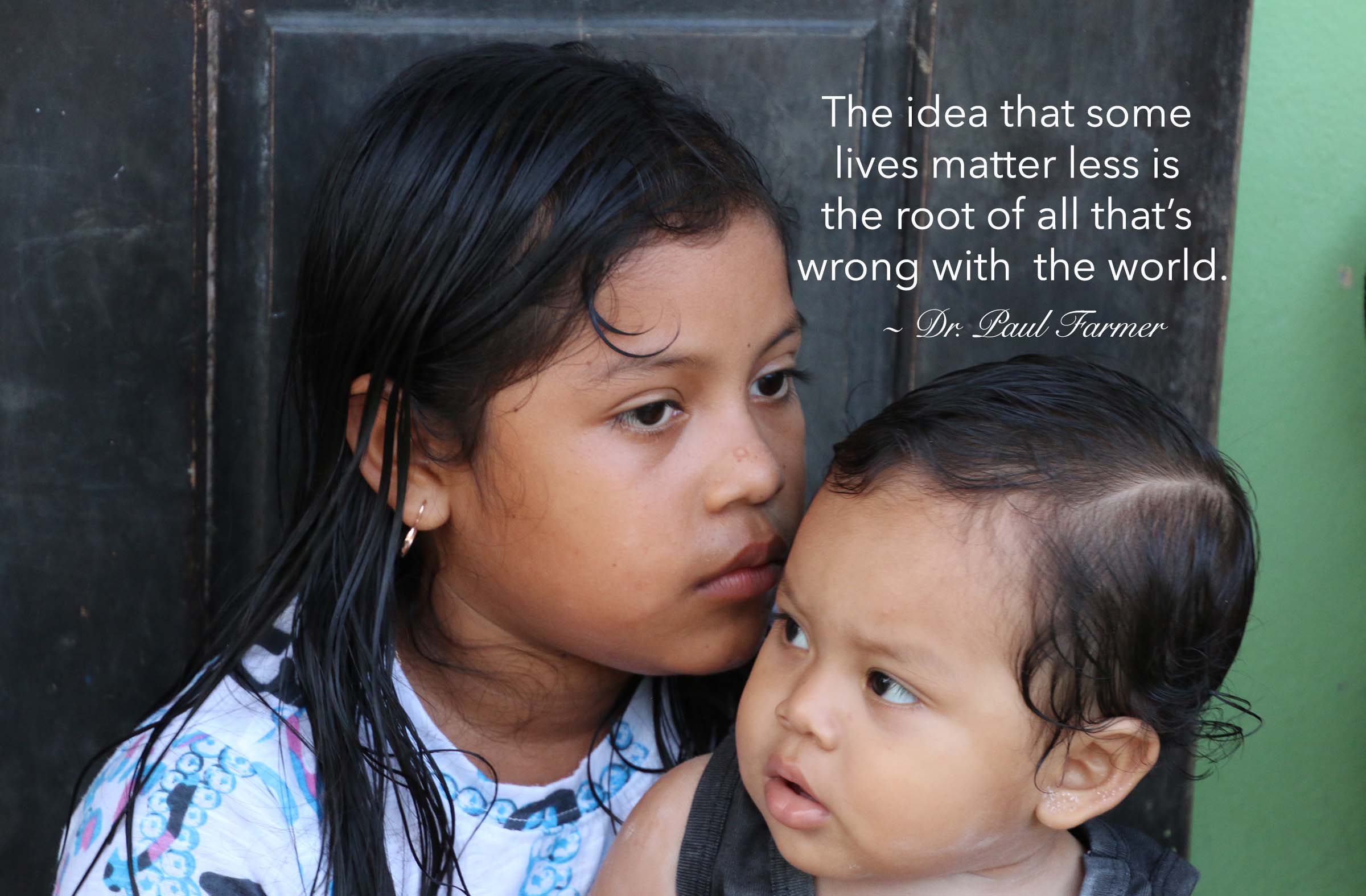
When I look at the news–the spread of COVID-19, the national and global distribution of vaccine, the violence perpetrated against black and brown bodies, the turmoil at our southern border–I can’t help but return time and time again to Dr. Farmer’s enduring truth.
And no, it isn’t just a matter of saying “all lives matter.” We have to own the fact that our world is currently built on the unsustainable premise that some lives matter less. That is what we have to face up to and work to correct.
That’s all I have for today. I’ll let these children’s faces speak the rest of what needs to be said. Please listen with your heart.

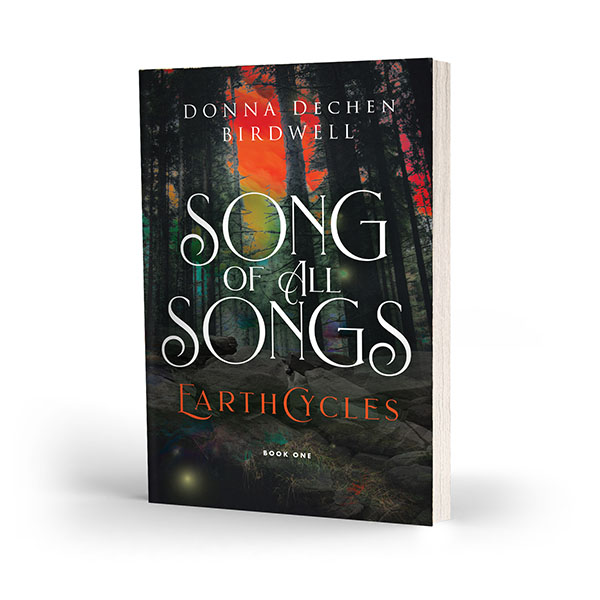
Long after the apocalypse, Earth has repeopled itself. Twice.
Despised by her mother’s people and demeaned by her absent father’s legacy, Meridia has one friend—Damon, an eccentric photologist. When Damon shows Meridia a stone he discovered in an old photo bag purchased from a vagrant peddler, she is transfixed. There’s a woman, she says, a dancing woman. And a song. Can a rock hold a song? Can a song contain worlds? Oblivious of mounting political turmoil, the two set out to find the old peddler, to find out what he knows about the stone, the woman, and the song. But marauding zealots attack and take Damon captive, leaving Meridia alone. Desolate. Terrified. Yet determined to carry on, to pursue the stone’s extraordinary song, even as it lures her into a journey that will transform her world.
I struggle most days, in the midst of this pandemic, to edit my next book, to prepare it for publication, to write the next story after this one. I rarely turn out more than a few hundred words a day and sometimes none at all. I have to ask myself: Why am I doing this? Why does it matter that I write? Why does it matter that I write this particular story?
For one thing…if I should die of this damn coronavirus thing, I don’t want to leave behind an unfinished manuscript.
But that’s not enough. Why is this story something I want to finish?
What is it about?
It’s about humanity. About all the things that may or may not be “human nature.” About our diversity and how diversity is the bedrock of survival.
It’s about a woman who thinks, because she is biracial, that she is nothing. And then discovers that she is everything.
It’s about people who hate and distrust and misunderstand one another and then end up needing one another to survive.
It’s about us.
I’m ready to launch Song of All Songs on August 28. I’m ready to tell you a story I believe in.
Somebody on Twitter asked: “Have you ever experienced racism? Tell us your story.”
There are two ways to experience racism: As a victim and as a beneficiary. I have experienced racism as a beneficiary. It’s called “white privilege.”
And the more I observe the victims of racism, the more undeserving I feel of its benefits.
I am no more deserving than my black brothers and sisters of being able to walk (or jog) down the street without being harassed.
I am no more deserving than black Americans to feel only mildly annoyed when a cop pulls me over on the highways or city streets.
I am no more deserving than they are of living in a comfortable home in a “safe” neighborhood.
I am no more deserving than they are of being able to watch birds in a city park without others feeling threatened by my presence.
It’s been said that America will never truly rise to greatness until we undergo the genuine soul-searching and structural realignments demanded by “truth and reconciliation.” This week I’ve seen a lot of people encountering some big truths about America and who we have been (and still are) as a racially divided nation. There’s a lot more to come. And the reconciliation will never come without uncovering all of the shameful truths about our nation’s history and about how I and others like me have benefitted while others suffered.
It’s time.
You might also want to read my previous post, “This is Not a White Country.” Or this broader take on the notion of “Privilege.“

A protester carries a U.S. flag upside, a sign of distress, next to a burning building Thursday, May 28, 2020, in Minneapolis. Protests over the death of George Floyd, a black man who died in police custody Monday, broke out in Minneapolis for a third straight night. (AP Photo/Julio Cortez)
I got up this morning experiencing a sense of déjà vu that sent me looking for my bound volume of all the campus newspapers from my senior year in college—1969-1970. I was editor-in-chief that year, so there’s a lot of me on those pages, from editorial decisions about what got covered and what went on the front page to editorial statements (many, in retrospect, rather outrageous!) about everything that was going on that year.
There was a lot going on. There was a Moratorium declared in opposition to the Vietnam War. On December 2, 1969, there was the infamous draft lottery. We put out a special issue on the environment in March of 1970. There was also the Texas Pop Festival and skinny dippers in Turtle Creek. But I think what prompted my déjà vu was the memory of our black students’ association (yes, we had one at SMU) and the list of demands they drew up and how meticulously we tried to cover them in the student newspaper. We got criticism for that.
The previous year, in May of 1968, I had submitted a term paper in which I cited numerous political theorists and a few black activists. The paper concluded that white America had long since declared war on black Americans and that black people had every right to fight back, including with violence. I quoted extensively from James Baldwin and even included one citation of Stokely Carmichael’s writings.
There had been repeated riots through the 1960s. We may have thought that the Civil Rights Act and school integration and a few other achievements would fix things. More recently, we may have thought that having a black President would fix things.
Nothing has been fixed. The past decade has seen a vicious resurgence of (never dormant) white supremacy with its constant toxic handmaiden, white privilege. And black people and other people of color have had enough. The current pandemic has revealed the deadly extent of existing economic and healthcare inequalities. The murder of George Floyd forced us to see what we haven’t wanted to see: The heritage of slavery and Jim Crow are with us still.
When people time after time are pushed to the brink, when they ask for and then beg for and then demand change and nothing changes, eventually something explodes.
When it’s a gas fire, you don’t just spray water. You turn off the gas. And until we address the very real structural inequalities that exist within our society, we’re going to keep having explosions. Maybe even some big ones.


 Donna Dechen Birdwell