Tea for Two Sisters

IMG_2368

Tuesday is my night for Zen Writing Group at the Austin Zen Center. Our “prompt” tonight was a short video showing two Japanese girls (some people said mother and daughter, I saw two sisters) at a traditional tea ceremony. Both audio and subtitles were in Japanese. Here is what I wrote: 

“I’m thirsty.” Angie said. “I want a Coke. Buy me a Coke, sister.”

Maxine was looking after her younger sister for the afternoon. Their parents had left Maxine enough money to go down to the McDonalds and buy a Coke, but Maxine didn’t want to go.

“I’m not buying you a Coke, Angie,” she said. “You drink too many Cokes anyway.Go make a cup of tea instead.”
 “Are you kidding me?” Angie just stood there with her hands on her hips. “I don’t drink tea… not that hot stuff anyway. Besides… I don’t know how to make it.”
“Well, you should learn, Angie,” Maxine said. “Come on, nuisance. Come in the kitchen and I’ll show you how to make a cup of tea.”
Angie rolled her eyes, but she followed Maxine into the kitchen, resting her elbows on the counter, her chin in her hands. She would watch.
“First,” Maxine said, “we need water.” She turned on the tap and out came the water. She filled the electric kettle, placed it back on its base and and flipped the switch to “on”.
“How does the water get into the tap?” Angie asked.
“Oh.” Maxine said. “I think it comes from the lake.”
“How does it do that?” Angie wanted to know.
“Pipes. Pumps. Filters – lots of stuff.” Maxine explained.
The two girls stood there, arms crossed, looking at the kettle, waiting for it to boil.
“Where did the kettle come from?” Angie asked.
“Target,” Maxine replied.
“Where did Target get it?”
Maxine sighed. “Probably from China, nuisance little sister. Don’t ask so many questions.”
“You mean people in China made our kettle?” Angie was looking at her reflection in the side of the kettle, making faces. “How did it get here?”
“Probably on a ship,” Maxine said. “In a big box inside a ship, I think. Then in a truck to get to the Target store. And people put it on the shelf. And we bought it.”
“What about the electricity to make the kettle get hot?” Angie said, poking at the electrical cord with her finger.
And so it went. The water, the kettle, the electricity, the tea, the little paper bags the tea was in, the ceramic mugs, the spoon, the honey. Angie kept asking and Maxine – getting into the game after a while – kept answering.
Finally Angie and Maxine sat down at the table with their two mugs of tea. Angie stirred her tea thoughtfully. “You know,” she said, “that’s a lot of stuff that went into this cup of tea.”
“Yeah,” Maxine smiled. “A lot of stuff.”
Angie sighed. “But I really did want a Coke.”
Blog Redux

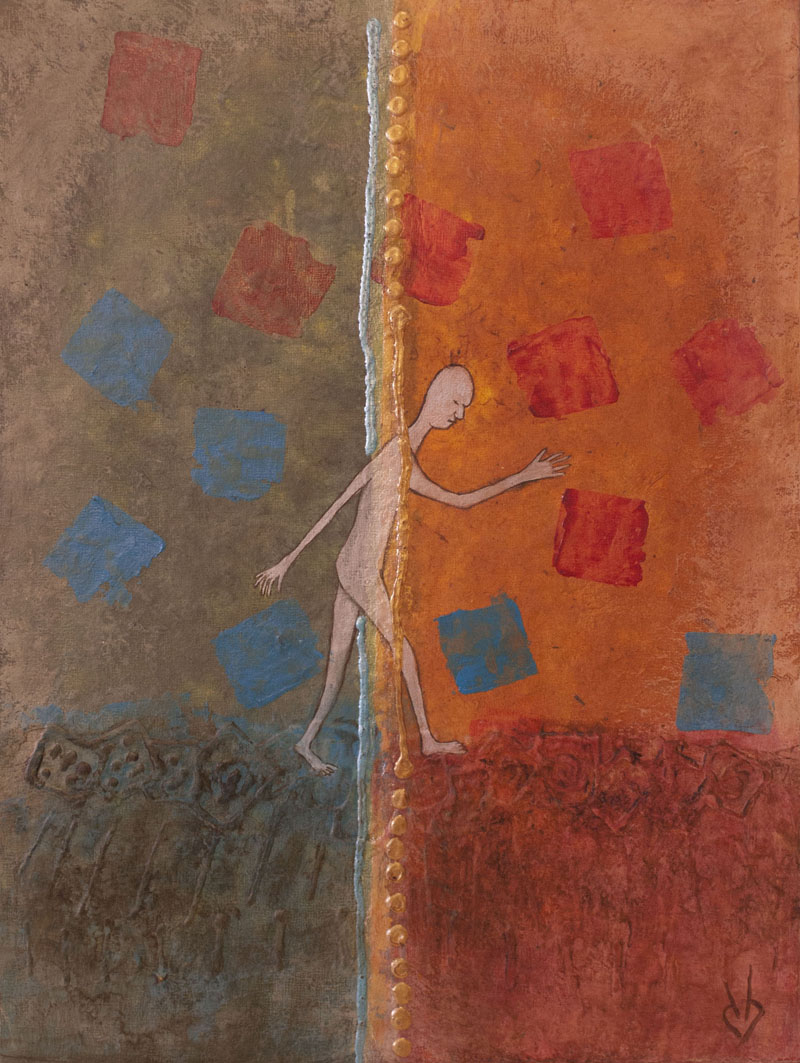
Just Passing Through, 8 x 10

A year ago, I had just returned from travels abroad, during which I had diligently blogged and sketched my way through Spain, France and Nepal. Realizing that my journey is not just about travel, I am declaring a resumption of the blog, to include at least occasional sketches and artworks. The new blog title – “Simulacrum” – is meant to convey something about my intention to write and draw and paint in ways that will evoke, however imperfectly, something nearly true about this world we share.

The novel I have recently completed – Way of the Serpent – is a work of “speculative fiction”, akin to science fiction but without the space aliens and mutant beasts. It takes place barely more than 100 years in the future, and my protagonist and friends are only too human. I say the novel is “completed”, but hesitate to use the word “finished,” as that would imply it has reached a state of such perfection that no further tinkering is permitted. I reserve the right to tinker.

There is a second novel in the works – The Fourth Time. It takes place in the here and now… sort of. My protagonist in this one is an archaeologist married to an author who writes about time travel, and much of the action takes place in Belize, a country I have known since my earliest anthropological fieldwork in the 1970s. This one is about 30,000 words to date.

And then there is the germination of a sequel to Way of the Serpent, which I am provisionally calling Flight of the Owl. It will follow the experiences of one of the survivors of Serpent. This one frightens me a little bit, but I’ll get over it and get into it soon enough.

(NOTE: I have just reposted some of my sketches from last year that I was unable to properly blog from Nepal due to technical difficulties.)

Can’t Get This on eBay (9/26/2013)

IMG_0220

One of the most distinctive things about human beings is our imagination. We can invent things that never existed before. We can discern relationships between seemingly unrelated things. There would be no scientific hypotheses without a little imagination. With imagination we can make up stories about people who don’t exist and things that never happened. We can even hold things in our mind that are totally untrue or even impossible. And we can draw pictures of them. Although this can be quite entertaining, it can also be dangerous! So sometimes we need to just sit down and shut up and see what reality is like when we are not imagining it into existence.

Nothing (9/16/2013)

IMG_0225

Yesterday Zen master Thich Nhat Hanh ( who I was privileged to meet up with back in 1968 or 69) sat in front of a crowd of folks in Boston and did nothing for almost half an hour.
There is an art of doing nothing, and it is not just about meditation. It is also about being able to wake up with no plans.. and no fear of no plans, no compulsion to fill the time with doing SOMETHING. Being alive to the moments as they come. So alive, in fact, that a whole day becomes just one life-filled timeless moment. What is there to do? Nothing. Go!
(Actually, I am not yet very good at doing nothing. But I’m working on it. Oh, wait! I think maybe I’ll just let it work on me…)

Navigating the French Countryside

Over the past 3 days, I have spent a lot of time driving my little black rental car through the southern French countryside.  It is beautiful country.  And we are not talking delicate beauty here!  No, this is a strong, robust beauty that has held up well to the abuse of human occupation over 300 millennia.  Even our attempts to construct a modern road system keep running up against things like massive rivers and towering rock faces that stretch for hundreds of yards.

That, in any event, is my explanation for why me and my petite voiture kept going in circles.  I was lost several times, and I mostly just enjoyed the view.  But today when I was searching for the little auberge I had booked for my night’s rest, I did not enjoy it so much.

My adventure has fostered a deeper respect for our ancient forbears who managed to navigate this countryside without maps or GPS.  But then… they would have seen, heard, felt, and smelled things that I totally missed as I whizzed through in my closed compartment with wheels.

Between Earth and Sky

image

Watching a group of European Buddhists perform traditional Tibetan dance this past weekend, I was particularly taken with the bearing of one of the men as he danced.  Tibetan dance is very different from most classical forms of western dance.  I had a few lessons some time back and found it challenging but intriguing.

What struck me about this one dancer last weekend was the way he was fully grounded and yet buoyant in his bearing.  Tibetan dance incorporates heavy footfalls and slow turns on one foot followed by light, even placement of the next foot.  And yet the head and shoulders must be lifted.  It is a tough combination.

I think I might try Tibetan dancing again someday…

Original Art

The word “original” comes from origin, the source. Today I saw some truly original art In a couple of caves here in France’s Dordogne valley. Thinking about the absorption of these prehistoric artists as they etched images into limestone with sharp flints or applied black and red colors, probably by a technique I used to describe to my anthro students as “spit painting”… I was overwhelmed. Although I cannot know exactly what their motivation was, I can know without a doubt that this was something important.

As someone who struggles with drawing or painting BIG, I was also impressed with the scale of many of the paintings and etched drawings.  Of course, they are still far from life size, so maybe these ancient painters actually thought they were painting in miniature…

The image above includes some curious elements that are referred to as “technoformes”.  These were new to me, and I found them fascinating.  I don’t know what the experts are positing as their significance, but I can’t help seeing them as structures, maybe of wood and other perishable materials.  Maybe the first architectural drawings?